Nilfanion, CC BY-SA 4.0, via Wikimedia Commons
Leckhampton Hill and Charlton Kings Common
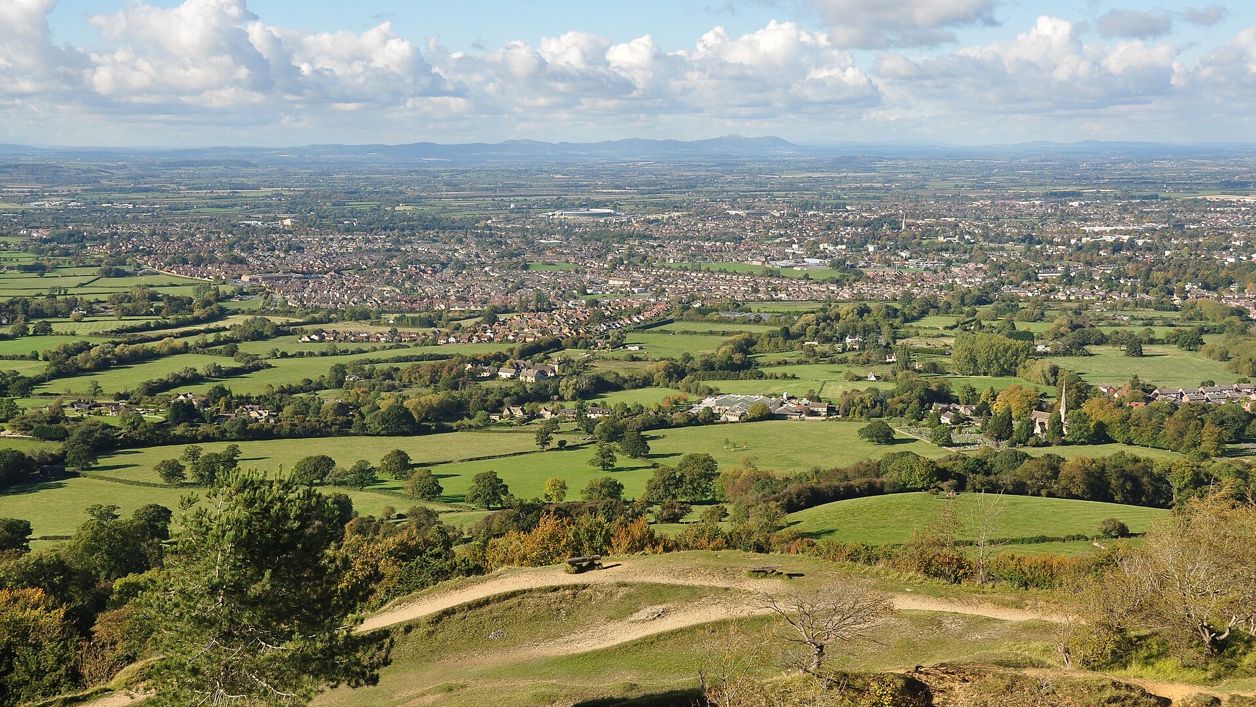
Leckhampton Hill and Charlton Kings Common: 60 hectares of old quarries, limestone grassland on the Cotswold Edge above Cheltenham, with an Iron Age hillfort and the Devil's Chimney. Opened to the public in 1929 after the riots of 1902; a National Nature Reserve from 2026.
Nature reserve
The Cotswold EdgeLeckhampton Hill rises above the south of Cheltenham on the Cotswold Edge, and with Charlton Kings Common beside it makes a reserve of 60 hectares (Cheltenham Borough Council's figure) of open common land: limestone grassland, scrub, woodland and the cliffs of old quarries, with an Iron Age hillfort on top and the Devil's Chimney below the edge. Owned by Cheltenham Borough Council, it was launched as a National Nature Reserve in June 2026.
History
Leckhampton Hill's story runs from an Iron Age fort through 150 years of quarrying to one of the best-known fights for public access in England.
The fort and the sheep run
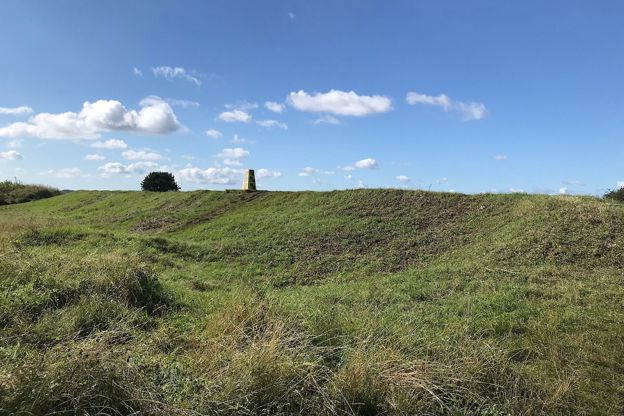
The summit carries Leckhampton Camp, an Iron Age hillfort with a single rampart, and beside it a round barrow inside a square enclosure, both scheduled monuments. Chance finds show the hilltop used again in Roman, Anglo-Saxon and medieval times, and through the Middle Ages the hill was a sheep run, grazed into the grassland that survives on it.
The quarries
Stone may have been dug here for much longer, but the recorded quarrying ran for about 150 years, from the late eighteenth century to the mid-1920s, along the scarp edge and at Brownstones on the top. Most of the stone was low grade, for roads, gravel and lime, though some was good enough to be carved inside Cheltenham College Chapel. Around 1875 the quarries produced about 8,000 tons a year, and about 50 men worked on the hill around 1915. Tramways and inclines carried the stone down. In the early 1920s a government loan meant to ease unemployment after the First World War paid for four big limekilns part way up the hill, able to burn 300 tons a day; the venture failed and had closed by 1927.
The riots of 1902 and the Stalwarts
In 1894 the quarry owner Henry Dale bought the hill and wrote to the rural district council refusing to admit any public right of access. In 1897 he built Tramway Cottage for his foreman at the foot of the middle incline, all but blocking the main footpath to the hill, and in 1899 he fenced off 26 acres of the northern slopes. On 8 March 1902 a crowd began pulling the fences down and finished on Good Friday. In July four men were arrested after a further protest; when they were acquitted, on the evening of 15 July about two thousand people turned the occupants out of Tramway Cottage and knocked it down. A London court upheld three public footpaths in 1904, but Dale rebuilt the cottage. On Good Friday 1906 another crowd of about two thousand attacked the cottage, the Riot Act was read, and eight men were jailed: the Leckhampton Stalwarts, one of whom has a memorial on the hill.
A hill for the town
Cheltenham Town Council bought about 400 acres, the hill and farmland from Salterley to the edge of Charlton Kings Common, in 1927, and the mayor opened it to the public in September 1929 from the foot of the limekilns. Charlton Kings Common followed in 1965. Plans to plant parts of the hill with trees in 1971 and the late 1990s met strong local opposition, and out of the public meetings came the Friends of Leckhampton Hill and Charlton Kings Common in 2000, who now help the council run it. In June 2026 Natural England declared the hill and common the 15th of the King's Series of National Nature Reserves, under the name Cheltenham Escarpment, with the chair of Natural England, Tony Juniper, welcoming the stronger protection for its geology and habitats.
What to see
Leckhampton Hill shows the rock of the Cotswolds better than almost anywhere: its quarry faces expose about 70m of Jurassic limestone, laid down in a shallow sea some 170 to 175 million years ago and full of shelly fossils. The Cotswolds National Landscape says the thickest sections of Jurassic rock anywhere in the country are exposed here and on Cleeve Common.
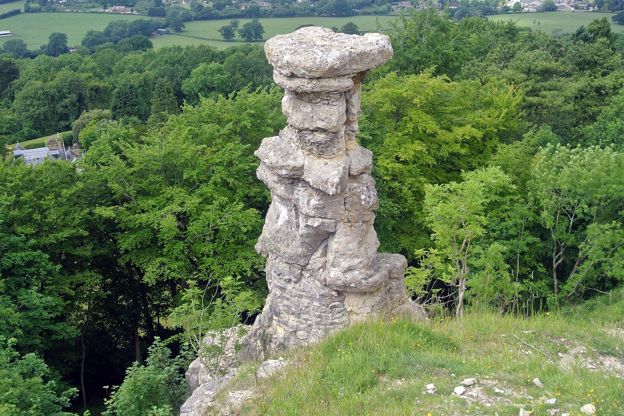
- The Devil's Chimney, the rock pillar below the scarp edge, probably left standing when an incline was cut and perhaps shaped by the quarrymen.
- The ramparts of Leckhampton Camp and the trig point on its eastern bank, with the view over Cheltenham and the Severn Vale to the hills of Wales.
- Some stonework of the 1920s limekilns and their ruined power house, with an information board nearby, and the old tramways and inclines, many of them now the paths up the hill.
- The named quarries: Salterley, Dead Man's and Brownstones.
- Common rock-rose, wild thyme, autumn gentian and purple milk-vetch, and orchids, among them musk and fly orchids.
- Some 33 kinds of butterfly, among them the small blue, marbled white, dark green fritillary, chalkhill blue and Duke of Burgundy, and glow-worms after dark in most summers.
Visiting
Leckhampton Hill and Charlton Kings Common are registered common land, free and open at all times, and you can roam anywhere on foot. A herd of Belted Galloway cattle, kept in place by GPS collars instead of fences, grazes the main grassland in autumn and winter and moves off it in spring and summer so the plants can flower and seed; a QR code on the notices shows where the herd is. Keep dogs on a short lead near them, let go of the lead if cattle threaten your dog, and keep dogs on a short lead everywhere from 1 March to 31 July, as on all open access land. The Friends list no toilets or café on the hill. The scarp is steep, the quarry rock is loose, and climbing on the Devil's Chimney is forbidden.
For visitors with limited mobility, a waymarked 3.6km scooter route starts from Brownstones car park on Hartley Lane on mostly level ground, and the council counts more than 3km of accessible paths on the reserve. Since a link past National Star College was finished, wheelchair users can go on from Crickley Hill, past the college, to Leckhampton Hill. Come between May and August for orchids and butterflies, or on a clear evening for the view west.
Getting there
For the climb, park at the Daisy Bank or Bridge car parks on Daisy Bank Road on the south edge of Cheltenham; for the top, use Salterley Quarry or Brownstones Quarry car parks at the east end of Hartley Lane. Walkers on AllTrails reported the Daisy Bank Road car parks free in September 2026; the Friends publish no charge. Crickley Hill is about 2.5km to the south-west, the next hill along the scarp. On foot, the Cotswold Way runs along the edge, our Leckhampton Hill and Devil's Chimney walk circles the common from Daisy Bank Road, and the Seven Springs and Leckhampton Hill walk comes over from the source of the Churn.
Nearby
Crickley Hill, with its café and its own hillfort, is about 2.5km along the scarp to the south-west, and Cleeve Common, the highest ground in the Cotswolds, is across Cheltenham to the north-east, with Cleeve Hill camp on its edge. Our page on where the Cotswolds are explains the limestone, and the accessible Cotswolds covers the scooter route. Below the hill, the Wheatsheaf on Old Bath Road is a family-run Wadworth pub with a large garden.
Walks past Leckhampton Hill and Charlton Kings Common
-
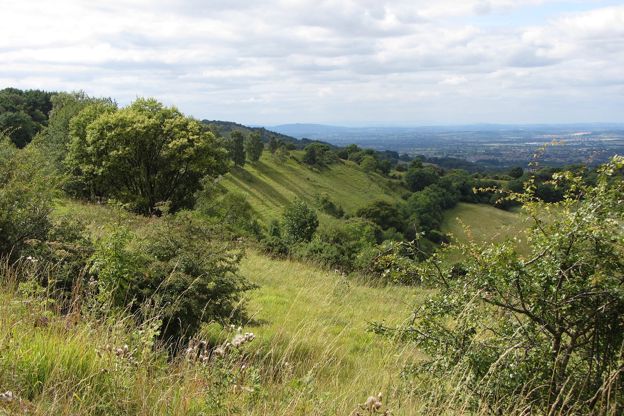
Cotswold Way: Dowdeswell to Leckhampton Hill
Walk · Starts in the Cotswold Edge · 3 hrs · Dog-friendly
A 4.7-mile (7.6km) one-way walk on the sixth section of the Cotswold Way, from Dowdeswell reservoir to Leckhampton Hill, moderate and about three hours: a stiff climb through Lineover Wood, field paths to Seven Springs, then Hartley Lane and Charlton Kings Common.
-
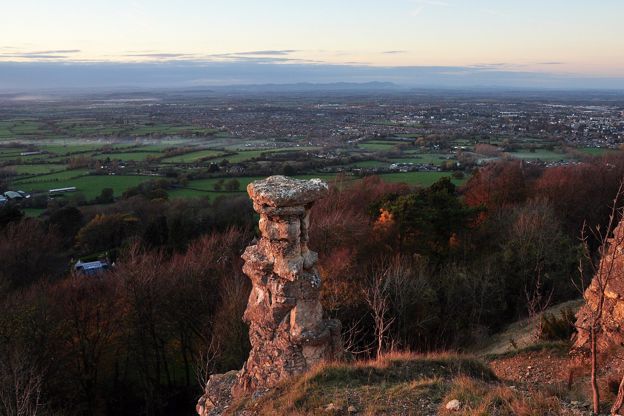
Leckhampton Hill and the Devil's Chimney
Walk · Starts in the Cotswold Edge · 2 hrs · Circular · Dog-friendly
A 4-mile (6.3km) circular walk from the Daisy Bank Road car parks above Cheltenham, about two hours and moderate, with one steep climb: round Charlton Kings Common, up onto the escarpment past the hillfort to the Devil's Chimney, and down the old quarry incline.
-
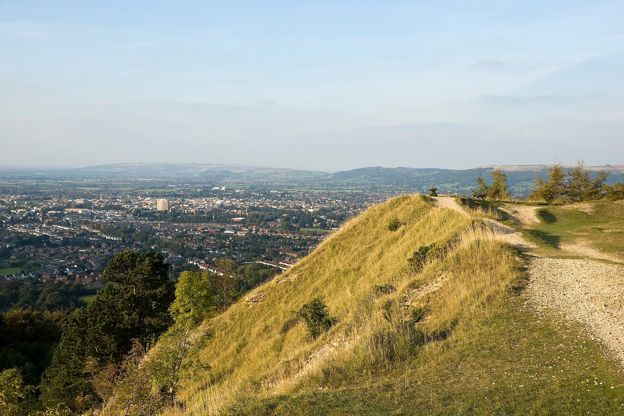
Seven Springs and Leckhampton Hill
Walk · Starts in the Cotswold Edge · 2 hrs, 30 mins · Circular · Dog-friendly
A 5.4-mile (8.7km) circular walk from Seven Springs, about two and a half hours and moderate, with steep slopes: along the Cotswold Way over Charlton Kings Common to the hillfort on Leckhampton Hill and the Devil's Chimney, and back along the foot of the common.
Stay and eat near Leckhampton Hill and Charlton Kings Common
-
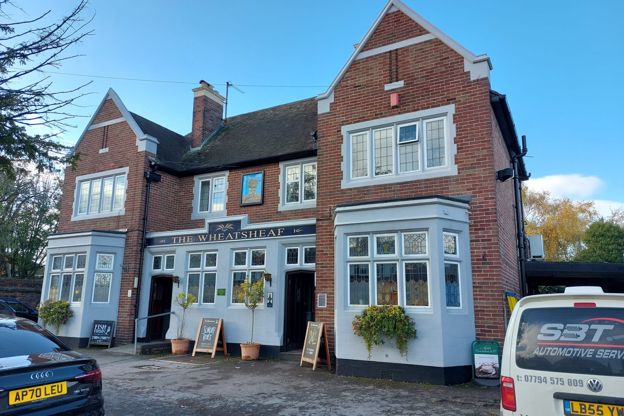
The Wheatsheaf, Leckhampton
Pubs · The Cotswold Edge
A family-run Wadworth pub on Old Bath Road in Leckhampton, below Leckhampton Hill, which Wadworth lists with a large garden, a heated patio, Sunday roasts and jazz and blues nights.
Dog-friendly · Family-friendly
Verified Nov 2026
-

StarBistro
Cafes and tearooms · The Cotswold Edge
The restaurant at National Star college in Ullenwood, above Cheltenham, where students with disabilities serve breakfast, lunch and afternoon tea on weekdays, on the line of the Cotswold Way's 2026 diversion.
Walker-friendly · Family-friendly
Verified Oct 2026
-
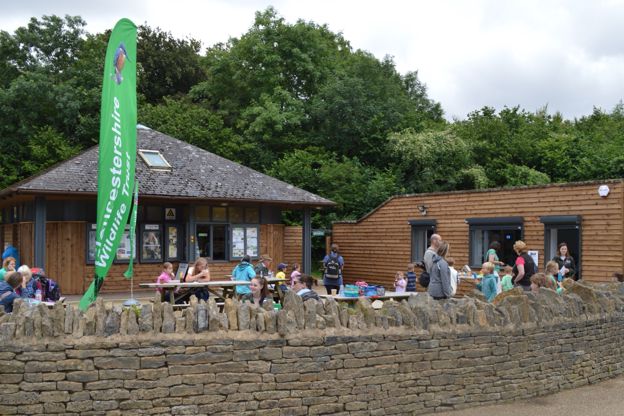
Crickley Hill café
Cafes and tearooms · The Cotswold Edge
Gloucestershire Wildlife Trust's café by the top car park at Crickley Hill Country Park, near Birdlip, on the Cotswold Way: breakfast, lunch and cakes, dogs welcome.
Dog-friendly · Walker-friendly · Family-friendly
Verified Nov 2026
Stories about Leckhampton Hill and Charlton Kings Common
-
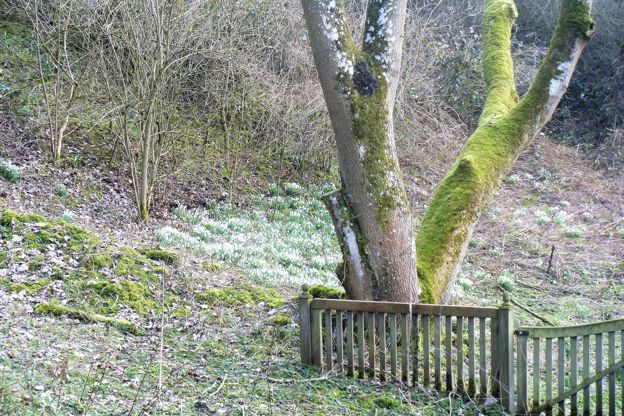
The Cotswolds in February
Story · Guides · 8 minute read
The Cotswolds in February: snowdrop month, with Colesbourne's weekends, Painswick's booked valley and Batsford, the Stroud Wassail, the first lambs, half term's one busy week, what is open, and three walks for the mud.
-
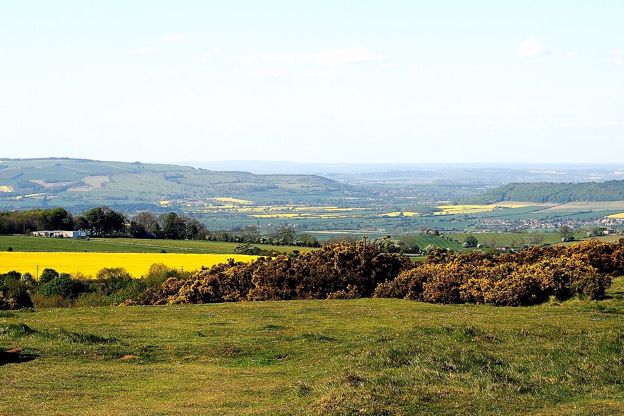
Where are the Cotswolds?
Story · Guides · 11 minute read
The Cotswolds are a range of limestone hills in south-central England, a National Landscape of 787 square miles across six counties, most of it in Gloucestershire. Here is where they are, what the boundary includes, and what makes the stone golden.
-
Why Cotswold stone is golden
Story · History · 9 minute read
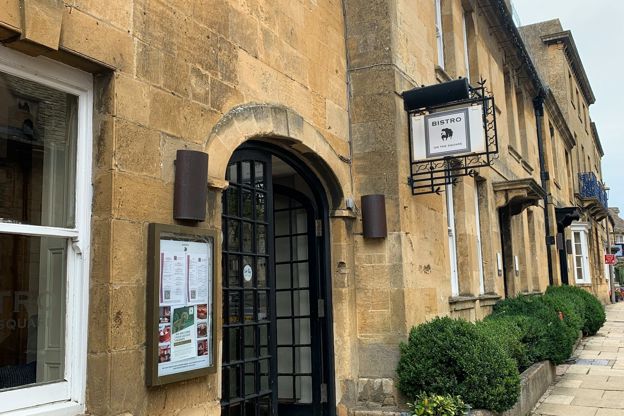
The Jurassic limestone that built the Cotswolds, the iron that colours it honey in the north and grey in the south, the quarries at Taynton, Barrington, Guiting and Painswick, the stone slate roofs and the dry-stone walls, and where to see each.
More sights to see
-
Leckhampton Camp
Sight · Hill fort or barrow · The Cotswold Edge
Leckhampton Camp is the Iron Age hillfort on the summit of Leckhampton Hill above Cheltenham: one rampart and a rock-cut ditch, an inturned entrance with two guard chambers and, to the east, a rare round barrow inside a square enclosure. Scheduled; the trig point is on its bank.
-
The Devil's Chimney, Leckhampton
Sight · Monument · The Cotswold Edge
The Devil's Chimney is a pillar of limestone standing below the scarp edge of Leckhampton Hill above Cheltenham, most likely left isolated when quarrymen cut an incline to the top and shaped by the weather since. Folklore says the Devil built it. Climbing it is forbidden.
-
Crickley Hill
Sight · Common or park · The Cotswold Edge
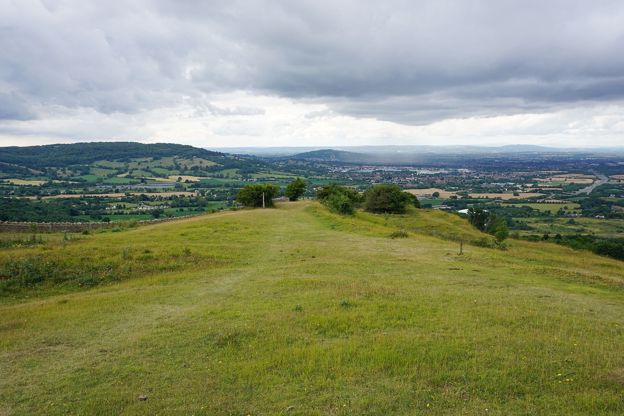
Crickley Hill is a Cotswold Edge promontory near Birdlip, cared for by Gloucestershire Wildlife Trust and the National Trust, where 25 years of digging found a Neolithic settlement destroyed in battle and an Iron Age hillfort. Grassland, beech wood, a café and views to Wales.