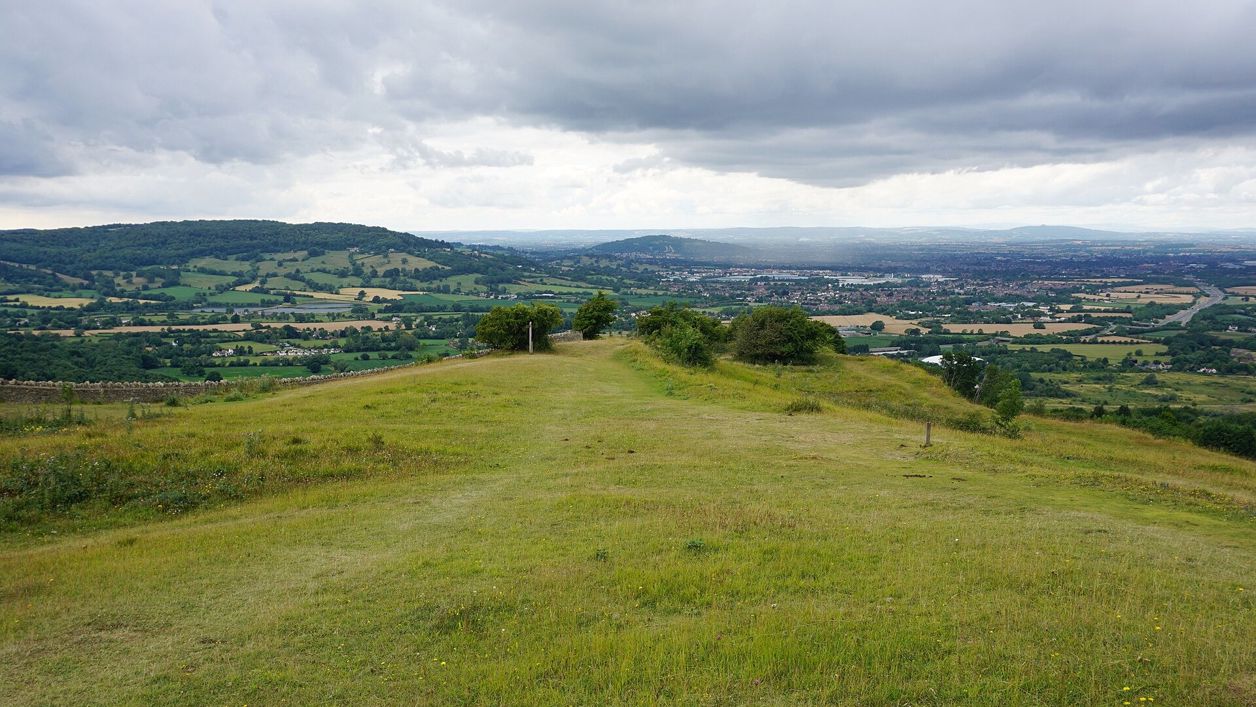
Bill Boaden, CC BY-SA 2.0, via Wikimedia Commons
Crickley Hill
Crickley Hill is a Cotswold Edge promontory near Birdlip, cared for by Gloucestershire Wildlife Trust and the National Trust, where 25 years of digging found a Neolithic settlement destroyed in battle and an Iron Age hillfort. Grassland, beech wood, a café and views to Wales.
Common or park
The Cotswold EdgeCrickley Hill is a spur of the Cotswold Edge above the A417 near Birdlip, between Cheltenham and Gloucester, looked after by Gloucestershire Wildlife Trust with the National Trust. Its tip was settled by about 3650 BC, fought over, fortified again in the Iron Age, and excavated for 25 years; today it is 32 hectares of grassland, scrub and beech wood with one of the widest views on the scarp.
History
Crickley Hill was occupied, abandoned and reoccupied over more than five thousand years. Professor Philip Dixon of Nottingham University led 25 years of excavations here, from 1969 to 1993.
The Neolithic village and its battle
The first enclosure on the promontory was a causewayed enclosure, a ring of interrupted ditches, built around 3650 BC. About a century later it was replaced by a settlement inside a continuous ditch and palisade. That village was destroyed by attack: the excavators found hundreds of flint arrowheads clustered at its entrances and along the line of the palisade, the evidence of a prehistoric battle.
The Long Mound
In a quiet hollow of the hill runs the Long Mound, a bank about 110m long that the digging showed was built in stages over thousands of years: a Neolithic platform and shrine at its north end, an Early Bronze Age cairn, a stone circle broken up in the early Iron Age, and a last section added after 400 BC. Objects were still being buried in it in the Middle Ages.
The Iron Age hillfort
Around 600 to 500 BC a hillfort was built across the neck of the promontory, a rampart and ditch with a gated entrance. At first it enclosed rectangular buildings and later a group of roundhouses. The fort was destroyed by fire, then its defences were strengthened and people lived there again before it was finally abandoned. Gloucestershire Wildlife Trust now looks after the hill with the National Trust, and Historic England schedules the camp as a monument.
What to see
The view from the end of the spur is the first thing, out over the Severn Vale; the National Trust lists Robinswood Hill, May Hill, the Brecon Beacons and the Black Mountains among what you can see on a clear day. Barrow Wake, along the Cotswold Way towards Birdlip, gives another angle on it.
- The rampart and ditch of the Iron Age fort, cutting across the promontory, with the Neolithic settlement site on the promontory behind it.
- The site of the stone circle and the Neolithic platform at the end of the Long Mound; most of the mound itself is hidden in its hollow.
- Limestone grassland with common spotted and bee orchids in early summer and autumn gentian at the end of it; chalkhill blue and green hairstreak butterflies, and glow-worms on warm summer nights. The Wildlife Trust counts over 1,300 species recorded here.
- The semi-natural beech wood on the slopes, and the limestone cliff faces and scree of the scarp.
- Kestrels and red kites over the scarp, cuckoos in spring and green woodpeckers.
Visiting
Crickley Hill is free to walk on and the car park costs £2.50 a day, paid at the kiosk by the café or online within 48 hours; members of the two trusts pay too. The car park gates are locked overnight, at 6pm in winter and 9pm in summer, and there is a call-out charge if you are locked in. By the top car park are a café and visitor hub, both wheelchair accessible, with toilets including an accessible toilet and baby change. A circular trail laid out in 2019 suits all-terrain wheelchairs and pushchairs, and the Wildlife Trust hires out a Tramper mobility scooter, with limited availability; elsewhere expect steep scree paths, cliff faces, a road through the reserve and mud. Belted Galloway cattle graze from September to March, when dogs must be on a lead, and from March to July dogs go on a short lead on the open access land. Fires and barbecues are banned.
Come in June and July for orchids and butterflies, in late summer for gentians, or on any clear day for the view.
Getting there
Crickley Hill is off the A417 near Birdlip; the postcode for the car park is GL4 8JY, and it holds about 100 cars. Coaches, minibuses and large motorhomes cannot use the main car parks; a separate area costs £15 a day, booked at least seven days ahead. On foot, the Cotswold Way runs through the reserve on its way between Leckhampton and Birdlip, and Leckhampton Hill is about 3km to the north-east along the scarp. Since July 2025 a permissive path through the grounds of National Star College, suitable for wheelchair users, has linked the reserve with the Cotswold Way towards Leckhampton Hill. The Crickley Hill café by the top car park serves breakfast, lunch and cakes every day, and the Royal George in Birdlip is the inn where the Cotswold Way sections from Leckhampton Hill and to Painswick meet.
Nearby
Along the scarp to the north are Leckhampton Camp, Leckhampton Hill and the Devil's Chimney; further north is Cleeve Hill camp, and to the south-west Painswick Beacon and Haresfield Beacon, both with hillforts of their own. For days out with a family, see the Cotswolds with children; for the scooter and the easy trail, the accessible Cotswolds.
Stay and eat near Crickley Hill
-
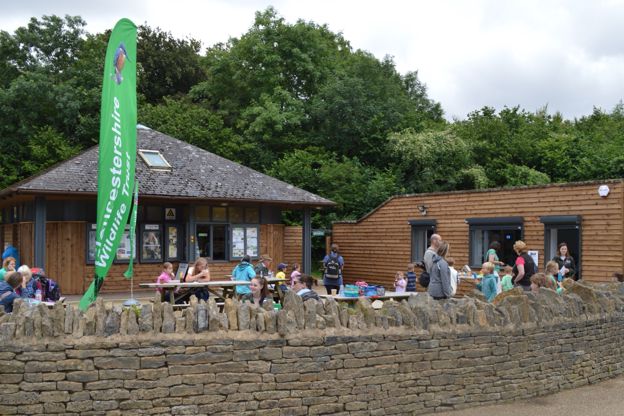
Crickley Hill café
Cafes and tearooms · The Cotswold Edge
Gloucestershire Wildlife Trust's café by the top car park at Crickley Hill Country Park, near Birdlip, on the Cotswold Way: breakfast, lunch and cakes, dogs welcome.
Dog-friendly · Walker-friendly · Family-friendly
Verified Nov 2026
-
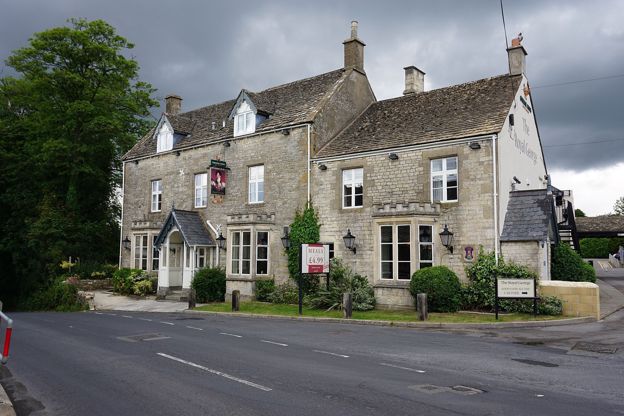
The Royal George Hotel
Pubs · The Cotswold Edge
An eighteenth-century inn in Birdlip, run by Greene King Inns, with a bar and restaurant of pub classics, a large beer garden and 34 bedrooms, where the Cotswold Way sections from Leckhampton Hill and to Painswick meet.
Dog-friendly · Walker-friendly · Family-friendly
Verified Oct 2026
-

StarBistro
Cafes and tearooms · The Cotswold Edge
The restaurant at National Star college in Ullenwood, above Cheltenham, where students with disabilities serve breakfast, lunch and afternoon tea on weekdays, on the line of the Cotswold Way's 2026 diversion.
Walker-friendly · Family-friendly
Verified Oct 2026
Stories about Crickley Hill
-
The accessible Cotswolds
Story · Guides · 12 minute read
The honest picture of access in the Cotswolds: which villages are level and which are cobbles and hills, the step-free days out, every Changing Places toilet we can confirm, Blue Badge parking, stile-free walks, accessible stays and getting about by train, bus and taxi.
-
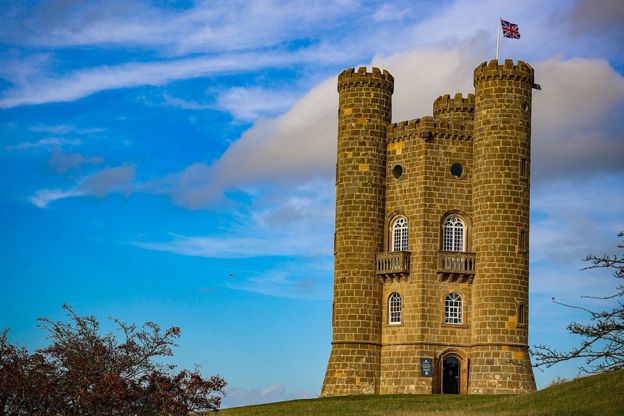
The best viewpoints in the Cotswolds
Story · Guides · 11 minute read
The best viewpoints in the Cotswolds, from Broadway Tower, Dover's Hill and Cleeve Hill to Haresfield Beacon, Crickley Hill and the Tyndale Monument: what you see from each, where to park and the walk that gets you there.
-

The Cotswolds with children
Story · Guides · 11 minute read
The Cotswolds with children, by age: the big family days out with how long to allow and what they cost, short walks with a river or a tower, rainy days, farm stays and family rooms, eating out, a sample day and weekend, and the school holiday crowds.
More sights to see
-
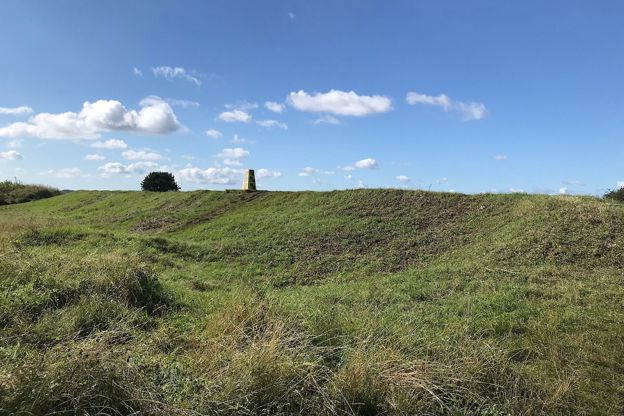
Leckhampton Camp
Sight · Hill fort or barrow · The Cotswold Edge
Leckhampton Camp is the Iron Age hillfort on the summit of Leckhampton Hill above Cheltenham: one rampart and a rock-cut ditch, an inturned entrance with two guard chambers and, to the east, a rare round barrow inside a square enclosure. Scheduled; the trig point is on its bank.
-
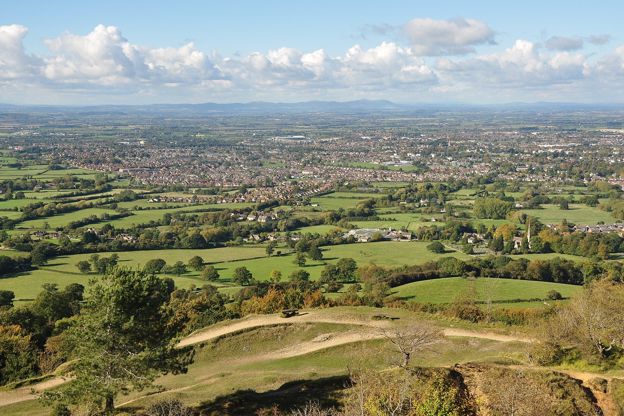
Leckhampton Hill and Charlton Kings Common
Sight · Nature reserve · The Cotswold Edge
Leckhampton Hill and Charlton Kings Common: 60 hectares of old quarries, limestone grassland on the Cotswold Edge above Cheltenham, with an Iron Age hillfort and the Devil's Chimney. Opened to the public in 1929 after the riots of 1902; a National Nature Reserve from 2026.
-
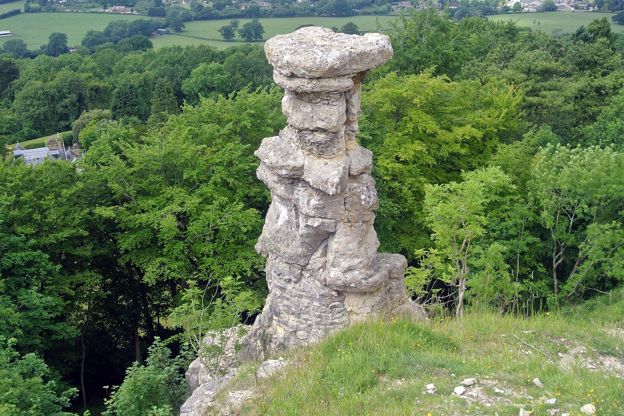
The Devil's Chimney, Leckhampton
Sight · Monument · The Cotswold Edge
The Devil's Chimney is a pillar of limestone standing below the scarp edge of Leckhampton Hill above Cheltenham, most likely left isolated when quarrymen cut an incline to the top and shaped by the weather since. Folklore says the Devil built it. Climbing it is forbidden.