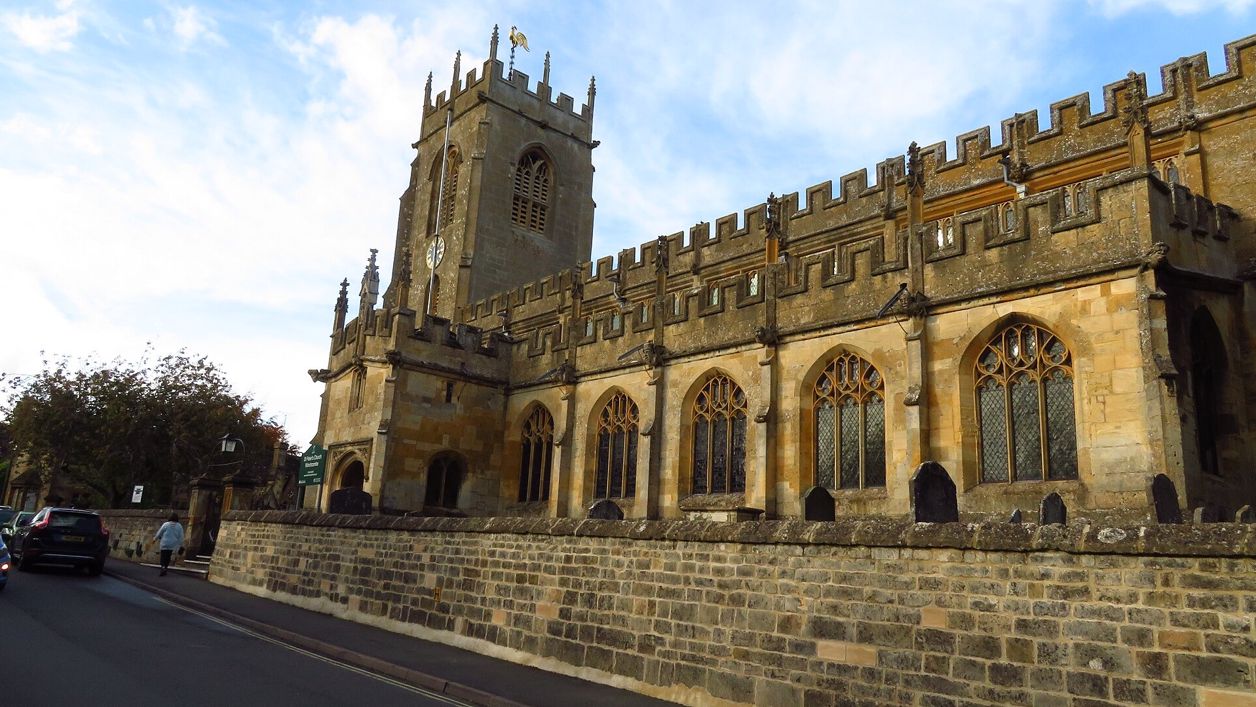
Colin Park, CC BY-SA 2.0, via Wikimedia Commons
St Peter's Church, Winchcombe
St Peter's is Winchcombe's Grade I parish church, built in one campaign in about 1458 to 1468, with some 40 carved grotesques round its walls, a fan-vaulted tower and two stone coffins tied to the St Kenelm story. Usually open daily.
Church
WinchcombeSt Peter's is the parish church of Winchcombe, on Gloucester Street in the middle of the town. It was built in a single short campaign between about 1458 and 1468, and it is listed Grade I. Most visitors come for the 40 or so carved heads that run round its parapets.
History
St Peter's was built in the 1450s and 1460s to replace the town's decayed parish church beside the abbey. Christian worship in Winchcombe goes back to Saxon times, and the earliest record of a church dedicated to St Peter dates from 1175, when it was closely tied to the Benedictine abbey that stood immediately to the east.
Abbot William and Lord Sudeley
For a time in the fifteenth century the townspeople worshipped in the nave of the abbey church, which suggests their old church had become unfit. The new building was paid for first by Abbot William of Winchcombe and then by Ralph Boteler, Lord Sudeley, who was rebuilding Sudeley Castle in the same years. Because it went up in one brief period, the listing calls it a regular church, all of one brief period, and from outside it still looks much as it did when it was finished.
After the abbey
The abbey was dissolved under Henry VIII and has been completely destroyed; nothing of it stands above ground today, so St Peter's is the town's great medieval survivor. The chancel had a steep roof put on in 1690. In 1870 the church was restored and refitted, and most of the pews date from then; in 1872 John Drayton Wyatt, who had worked with George Gilbert Scott on the almshouses of Dent's Terrace in 1865 and later built Vineyard Bridge, rebuilt the upper parts of the chancel. The gilded weathercock on the tower was bought from St Mary Redcliffe in Bristol in 1874, the church says.
What to see
St Peter's is a church to walk round outside before you go in. The grotesques run along the parapets of the tower, the nave and the aisles: about 40 heads, roughly half of them demons and beasts and the rest caricatures of local people. They are not true gargoyles, since most carry no water spout, and one of them, beside the south porch, is said to be Ralph Boteler himself.
- The tower: four stages with diagonal buttresses, large gargoyles and, inside, a fan vault under the tower arch.
- The south porch: two storeys, with a figure of St Peter in a niche, a fan-vaulted ceiling and a fine pair of eighteenth-century inner doors.
- The stone coffins: two of them stand at the west end of the aisles, associated with the legends of St Kenelm, the boy king whose shrine made the abbey a place of pilgrimage.
- The nave: six bays of octagonal pillars under a flat timber ceiling on cambered beams, and a large painted Royal Arms of George III's reign in the tower arch.
- The chancel: sedilia with nodding ogee heads, possibly older than the rest of the church, and angel corbels under the roof.
- The glass: medieval fragments in a south aisle window and the Lady Chapel, among good twentieth-century glass.
- The altar cloth: an embroidered cloth from the time of Henry VIII, kept behind a curtain to protect it from the light.
- The brasses: seventeenth and eighteenth-century brasses to townspeople in both aisles, and a fine alms chest on a pillar in the north aisle.
Visiting
St Peter's is open every day from 9.30am, closing at 4pm in winter and 5pm in summer, and entry is free. Services are held on Sundays and some weekdays, when visitors are asked to wait. The National Churches Trust entry, supplied by the church, gives level access to the main areas and says the church is dog friendly; A Church Near You lists a ramp, an accessible toilet, a hearing loop, baby changing and guidebooks. Come on a bright morning to see the grotesques on the south side in good light.
Getting there
St Peter's is on Gloucester Street (GL54 5LU), a few minutes' walk from the town centre. By car, free on-street parking is usually available on Gloucester Street and Abbey Terrace, and Back Lane car park behind the library is the nearest public car park. The 606 bus from Cheltenham stops in the town, run by Pulhams, roughly hourly in the day from Monday to Saturday, with no Sunday service.
On foot, the Cotswold Way's section from Winchcombe to Cleeve Hill starts a few steps away on Abbey Terrace, part of the Cotswold Way. The loop by Belas Knap and Cleeve Common passes the church on the way out of town, and the Winchcombe and Belas Knap walk starts at Back Lane, just behind it.
Nearby
The rest of Winchcombe is close by: the almshouses of Dent's Terrace on Abbey Terrace, Vineyard Bridge over the River Isbourne, and the gates of Sudeley Castle. Out of town, Hailes Church has medieval wall paintings, and St James' Chapel at Postlip is a Norman chapel on the Cotswold Way. For food, the White Hart and the Lion Inn are both a short walk away on the main street. St Peter's is one of the churches in our story on the Cotswold wool churches.
Walks past St Peter's Church, Winchcombe
-
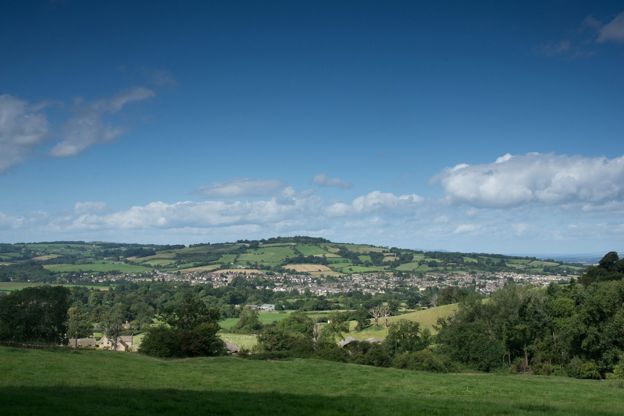
Cotswold Way: Winchcombe to Cleeve Hill
Walk · Starts in Winchcombe · 2 hrs, 45 mins · Dog-friendly
A 5.6-mile (9km) one-way walk on the fourth section of the Cotswold Way, moderate and two and a half to three hours: from Winchcombe by Sudeley up to Belas Knap, down through Breakheart Plantation to Postlip's Norman chapel, then up to the golf club on Cleeve Hill.
-
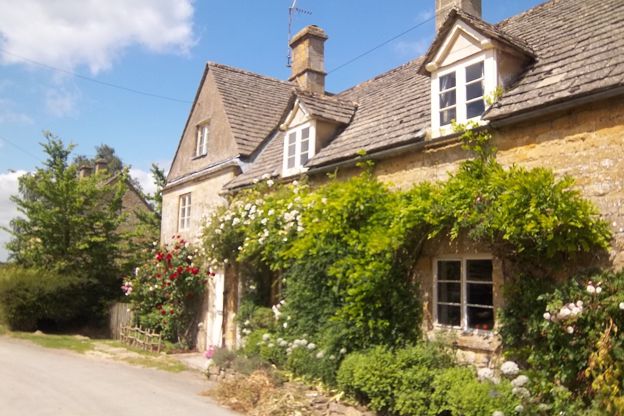
Cotswold Way: Wood Stanway to Winchcombe
Walk · Starts in Stanway · 3 hrs, 15 mins · Dog-friendly
A 5.4-mile (8.8km) one-way walk on the third section of the Cotswold Way, from Wood Stanway to Winchcombe, moderate and about three and a quarter hours: a steep climb to the top, Beckbury Camp, the old track down to Hailes Abbey, then lanes into the town.
-
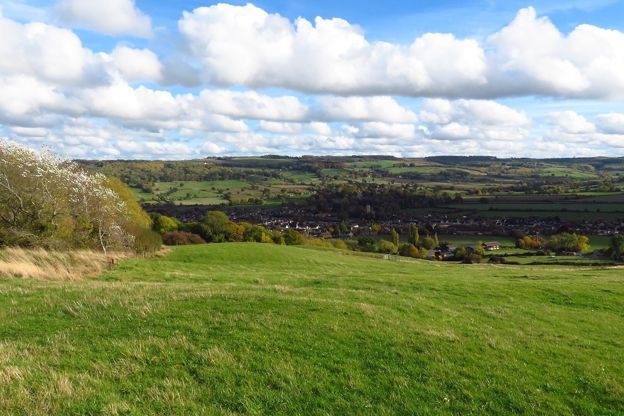
Winchcombe and Belas Knap
Walk · Starts in Winchcombe · 2 hrs, 45 mins · Circular
A 5.5-mile (8.8km) moderate loop of two to two and three quarter hours from Winchcombe, up the Cotswold Way and through the woods to Belas Knap, the Neolithic long barrow, then home on the Winchcombe Way by Wadfield Farm and Sudeley, with two stiles and a narrow road.
Stay and eat near St Peter's Church, Winchcombe
-
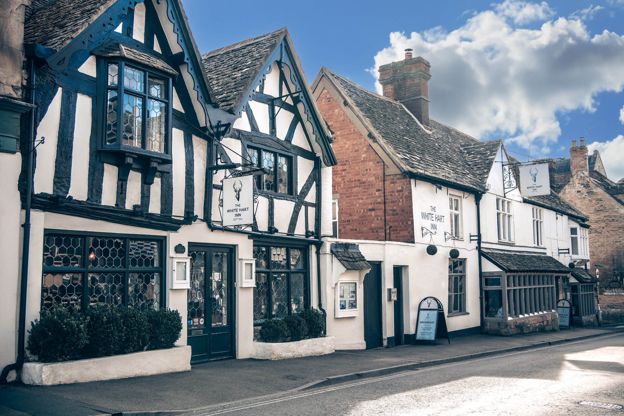
The White Hart Inn
Inn · Winchcombe
An inn with sixteen rooms on Winchcombe's High Street, with dog-friendly rooms and a restaurant and bar open all day to non-residents.
Dog-friendly · Wedding venues · Walker-friendly
Verified Nov 2026
-
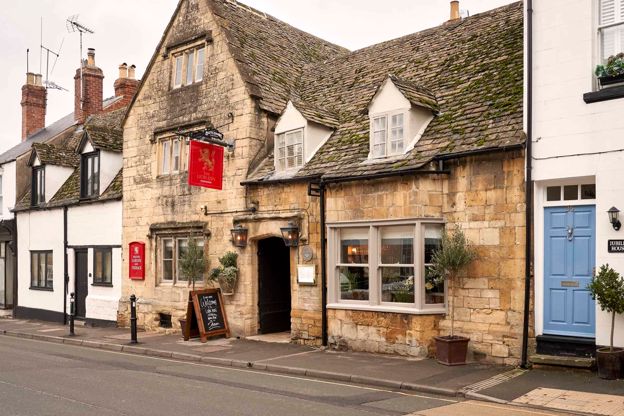
The Lion Inn
Inn · Winchcombe
A restored fifteenth-century coaching inn on North Street, Winchcombe, with nine rooms, run by Butcombe.
Dog-friendly · Walker-friendly
Verified Oct 2026
-
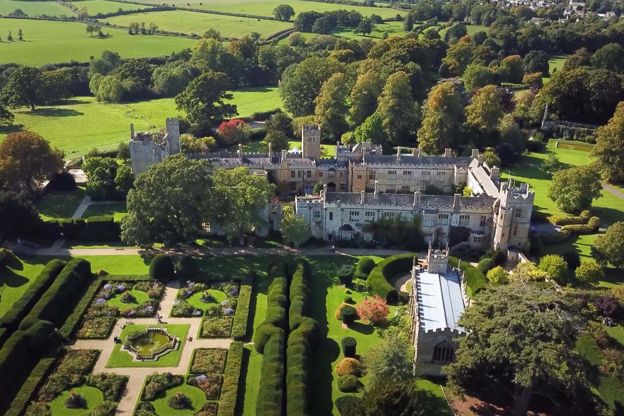
Sudeley Castle and Gardens
Historic houses and heritage · Winchcombe
A castle on the edge of Winchcombe where Katherine Parr, Henry VIII's last queen, is buried, with gardens, a Tudor history and the Dent family's home.
Family-friendly · Walker-friendly
Verified Nov 2026
Stories about St Peter's Church, Winchcombe
-
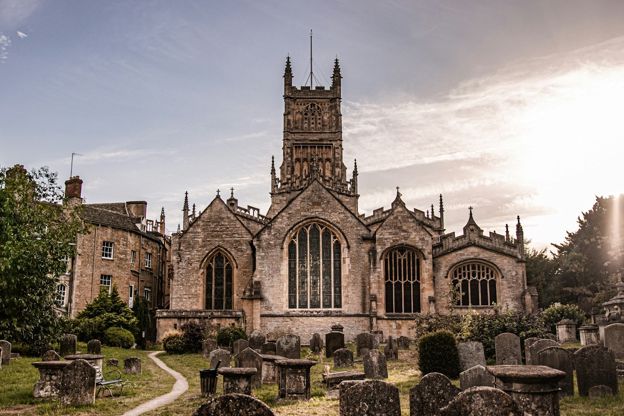
The wool churches of the Cotswolds
Story · Guides · 11 minute read
Northleach, Chipping Campden, Cirencester, Fairford, Burford and the other Cotswold churches rebuilt on medieval wool money: how the trade paid for them, what to look for in each, when they open and a route by car or on foot.
More sights to see
-
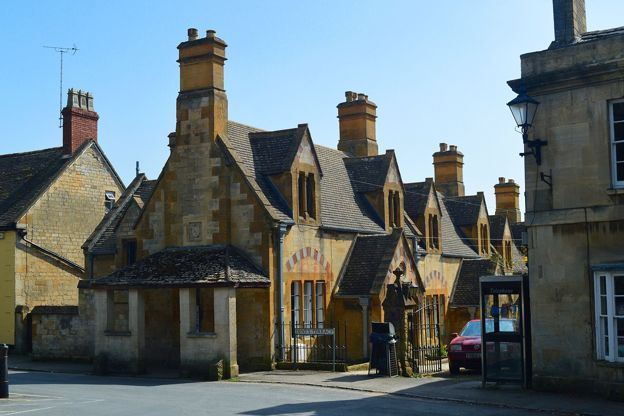
Dent's Terrace, Winchcombe
Sight · Historic building · Winchcombe
A row of ten almshouses of 1865 on Abbey Terrace, Winchcombe, by Sir George Gilbert Scott and J Drayton Wyatt for John and Emma Dent of Sudeley Castle: cream, yellow and pink stone under stepped gables. Grade II.
-
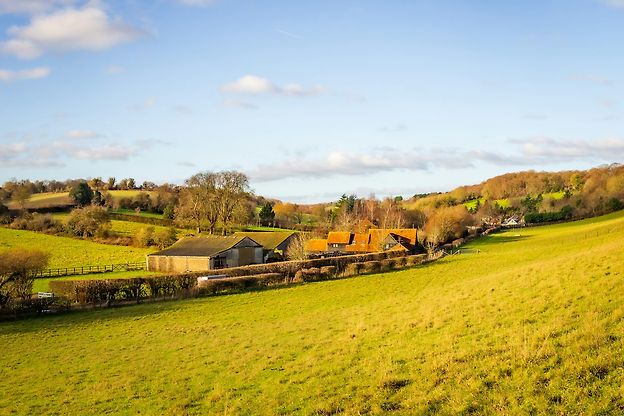
Vineyard Bridge, Winchcombe
Sight · Bridge · Winchcombe
Vineyard Bridge is the single stone arch of 1891 that carries Vineyard Street over the River Isbourne in Winchcombe, the last work in the town of the architect J. Drayton Wyatt and the way to Sudeley Castle. Listed Grade II.
-
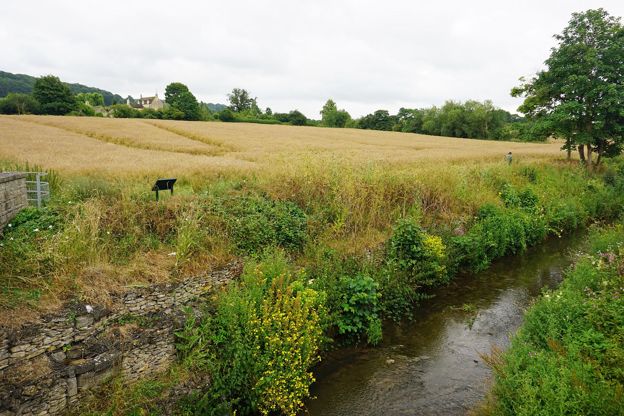
River Isbourne
Sight · River · Winchcombe
The River Isbourne rises at a spring on Cleeve Hill above Winchcombe and runs north past Postlip, Winchcombe, Toddington and Sedgeberrow to join the Avon at Evesham. A waymarked path of some 14 miles, the Isbourne Way, follows it.