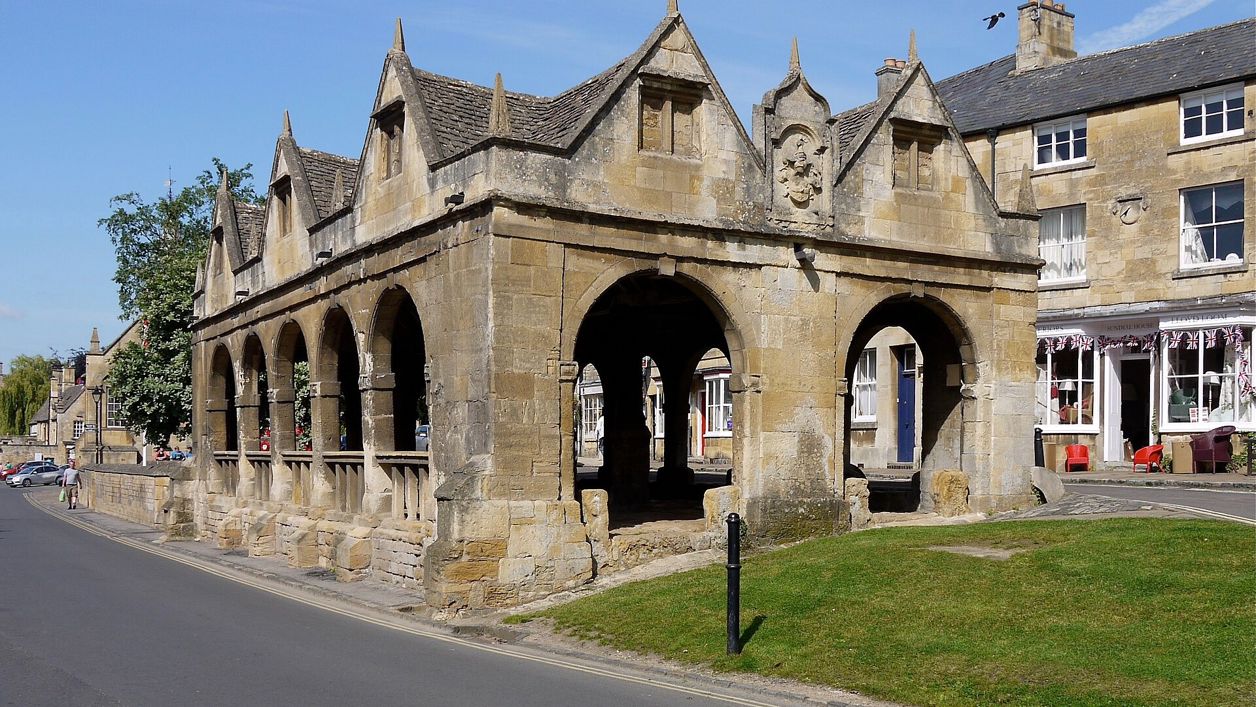
Mick, CC BY-SA 2.0, via Wikimedia Commons
Market Hall, Chipping Campden
The open arcade of 1627 in the middle of Chipping Campden's High Street, built by Sir Baptist Hicks as a sheltered market for butter, cheese and poultry, saved from sale to America in the 1940s and now the National Trust's. Grade I; the Cotswold Way starts beside it.
Historic building
Chipping CampdenThe Market Hall stands in the middle of the High Street in Chipping Campden, an open stone arcade that Sir Baptist Hicks built in 1627 to shelter the sellers of butter, cheese and poultry. In the 1940s the Campden Trust bought it to stop a sale to America and passed it to the National Trust. It is listed Grade I, and the Cotswold Way starts beside it.
History
The Market Hall was a produce market, not a wool market, as is sometimes said. The Chipping Campden History Society describes it as a butter market where women sold eggs, butter, cheese and bread under cover, and it may stand where an earlier market cross once stood.
Sir Baptist Hicks
Its builder made his fortune in London. Hicks was a wealthy silk mercer who supplied the Court, and Eton College's archive records him in 1585 as the mercer paying rent on the White Bear in Cheapside. He bought the manor of Campden in the first decade of the seventeenth century. In Campden he built a new manor house beside the church in 1612, gave the church its pulpit and lectern, had legal documents drawn up to protect the money John Fereby had left to found the grammar school, and built the almshouses on Church Street. The Market Hall, dated 1627, came two years before his death in London in 1629, and it carries his arms in a panel between the two gables at its east end, the same arms that are carved in the middle of the almshouses.
Carts, a sale and a rescue
By the 1850s the hall had become a store for carts: the history society has records of townspeople paying to keep the postman's mail cart there in 1857 and 1858, and early twentieth-century photographs show carts inside. Stone balustrades were added between the roadside arches in a renovation early in the twentieth century.
In the 1940s the owner offered it for sale, and a buyer planned to take it down stone by stone and ship it to America. The Campden Trust, the conservation society founded by the etcher F L Griggs, bought it first; a reader's note on the history society's page, citing Whitfield's history of the town, gives the year of the offer as 1942 and says it passed to the National Trust in 1944. The Trust owns it today. In December 2017, after the town's Christmas tree had gone up, the arm of a JCB struck it; the repair, in limestone from Oathill Quarry near Temple Guiting, was finished in December 2018.
What to look for
The hall is a double arcade of ashlar, five arches by two, under a stone slate roof with three gables on each long side. Pyramid finials stand on the gables and the corners. Look for:
- Hicks's coat of arms in an ogee-headed panel between the two east gables
- The inner row of chamfered stone piers on tall plinths, which carry the valley of the roof
- The cobbled floor, pitched paving in the listing, which the history society says is original and undisturbed since it was laid
- The roof, where the history society notes that each stone slate is pegged to a wooden strut; the waggon ceiling has lost its plaster
Stand at the east end and look down the High Street to see how the hall sits in the widening of the street where the market was held, with Grevel's House and Woolstaplers' Hall a short way along.
Visiting
The Market Hall is open in the street at all hours and free to walk through. The floor is uneven pitched stone. Public toilets with an accessible cubicle on the RADAR scheme are on Sheep Street, a few minutes away.
Getting there
By car, park in Back Ends, a lane behind the High Street, where the Cotswolds National Landscape asks walkers to park, or in the Market Square car park (GL55 6AW) beside the hall, which is free for the first 20 minutes, then charges from 7am to 7pm every day, takes cards or phone payment only and charges Blue Badge holders too. Stagecoach buses 1, 1A, 2 and 2A stop in the town on the way between Stratford-upon-Avon and Moreton-in-Marsh station, about every one to two hours from Monday to Saturday and less often on Sundays.
Several of our walks start or pass here:
- The Cotswold Way, 102 miles (164km) to Bath, starts beside the hall at a limestone marker stone carrying the National Trail acorn
- Chipping Campden and Dover's Hill, a 4.5-mile (7.2km) loop, starts at the hall
- Chipping Campden from Broad Campden comes along the High Street past it
- Chipping Campden to Blockley starts outside the Noel Arms, a few steps away
Nearby
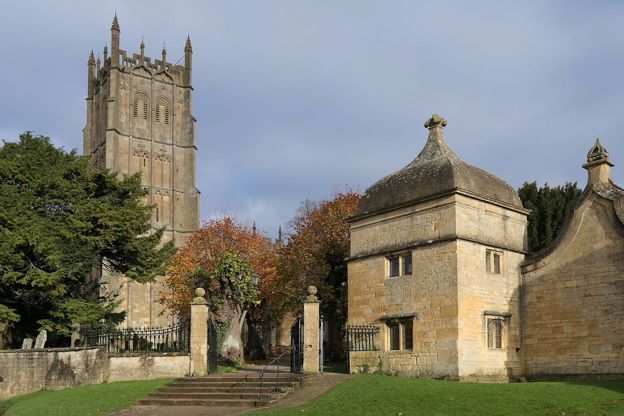
The hall is the centre of the High Street. St James's Church, the gateway of Old Campden House and the almshouses, all Hicks's work or his gifts, are a few minutes away along Church Street, and Dover's Hill is the first climb on the Cotswold Way. For tea, the Bantam Tea Rooms are a few steps away, and so are the Noel Arms and Cotswold House. Court Barn, on Church Street, is the museum of the Arts and Crafts makers who came to Campden in 1902. Our guide to Chipping Campden covers the rest of the town.
Walks past Market Hall, Chipping Campden
-
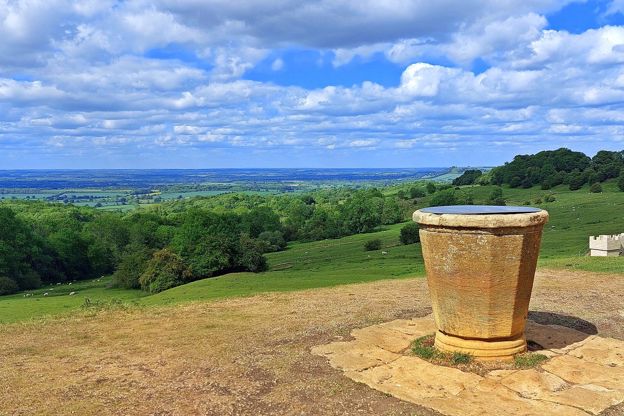
Chipping Campden and Dover's Hill
Walk · Starts in Chipping Campden · 3 hrs, 30 mins · Circular
A 4.5-mile (7.2km) circular walk from the Market Hall in Chipping Campden, two and a half to three and a half hours, moderate with steep sections. It climbs the Cotswold Way to Dover's Hill, home of the Olimpicks, and drops through Lynches Wood; a 3-mile version skips the climbs.
-
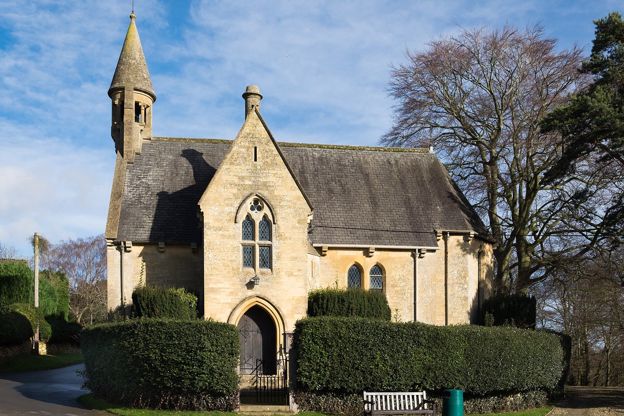
Chipping Campden from Broad Campden
Walk · Starts in Chipping Campden · 1 hr, 15 mins · Circular · Dog-friendly
A 3.3-mile (5.3km) circular walk from St Michael's church in Broad Campden, easy and mostly level, in about an hour and a quarter. It draws a figure of eight over the fields to Lady Juliana's Gateway, along Chipping Campden's High Street, by St James's and back.
-
Chipping Campden to Blockley
Walk · Starts in Chipping Campden · 3 hrs, 45 mins · Circular
A 9-mile (14.5km) circular walk from the Noel Arms in Chipping Campden to Blockley and back, about three and three quarter hours of moderate walking with 306m of climbing. It goes by Broad Campden, the Monarch's Way and Norcombe Wood, with five stiles and 200m of busy road.
Stay and eat near Market Hall, Chipping Campden
-
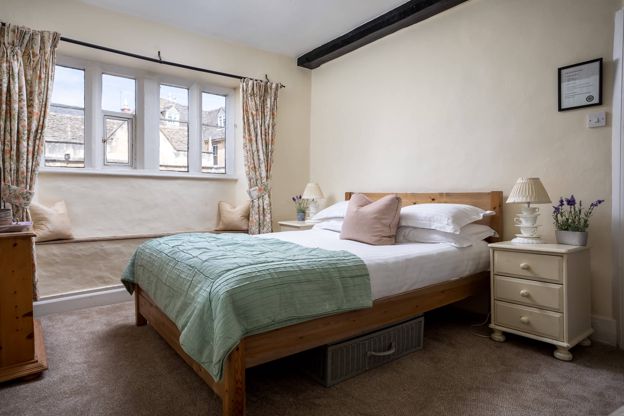
Bantam Tea Rooms
Cafes and tearooms · Chipping Campden
Tea rooms with rooms on the High Street in Chipping Campden, open every day from 9.30am to 5pm.
Verified Oct 2026
-
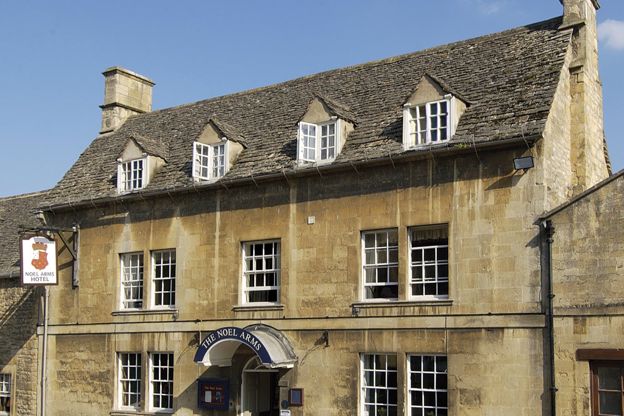
The Noel Arms Hotel
Inn · Chipping Campden
A Grade II listed inn with 27 rooms on Chipping Campden's High Street, with a restaurant, parking, accessible rooms and dogs by arrangement.
Dog-friendly
Verified Oct 2026
-
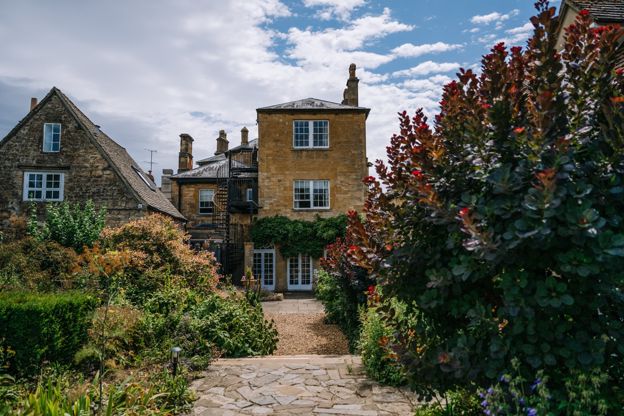
Cotswold House Hotel and Spa
Hotel · Chipping Campden
A Grade II listed Regency town house on Chipping Campden's Upper High Street, now a hotel and spa with the Hidcote restaurant.
Hot tubs · Wedding venues
Verified Nov 2026
Stories about Market Hall, Chipping Campden
-
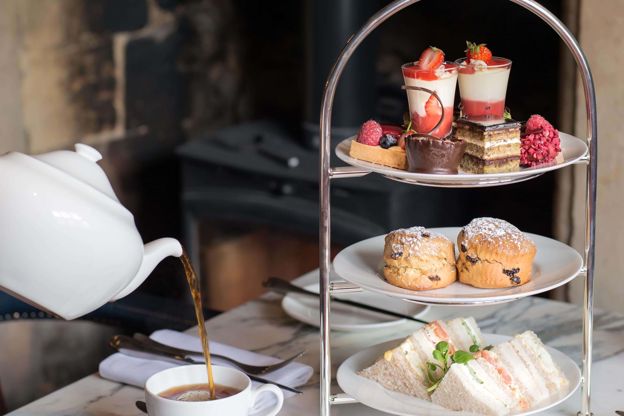
Afternoon tea in the Cotswolds
Story · Guides · 10 minute read
Where to have afternoon tea in the Cotswolds: country house hotels at the Slaughters and Buckland, old inns in Woodstock, Broadway and Malmesbury, and tearooms in Chipping Campden, Stow and Bourton, with times, prices and booking.
-
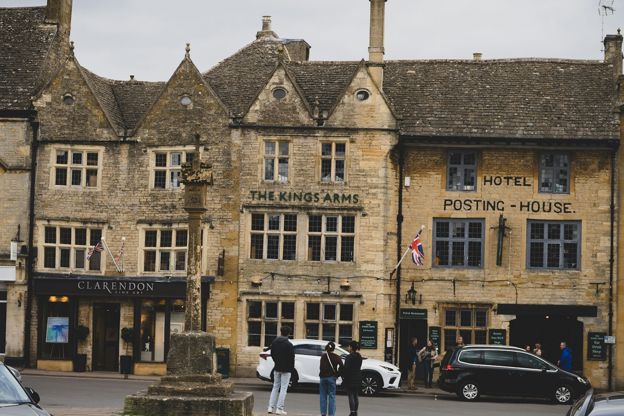
Antiques and shopping in the Cotswolds
Story · Guides · 9 minute read
The antiques towns of Stow, Tetbury, Burford, Broadway and Cirencester, the shopping villages, the makers of Chipping Campden and Stroud, the fairs, the bookshops, Daylesford and Burford Garden Company, and what the Cotswolds are known for buying.
-
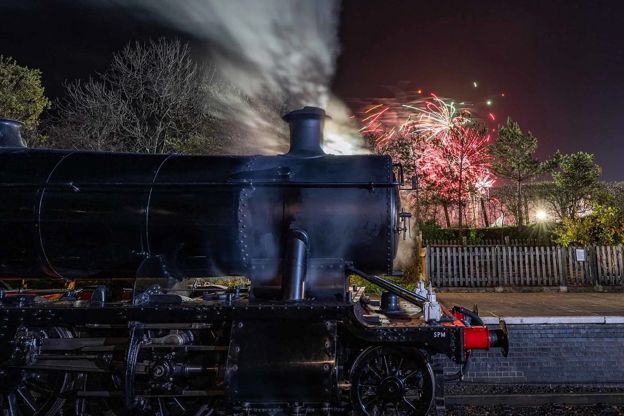
Christmas in the Cotswolds
Story · Guides · 10 minute read
Christmas in the Cotswolds: Blenheim's and Sudeley's light trails, Christmas markets at Cogges and Stroud, steam trains to Broadway's late-night shopping, candlelit carols, Boxing Day mummers, winter walks and inns with fires.
More sights to see
-
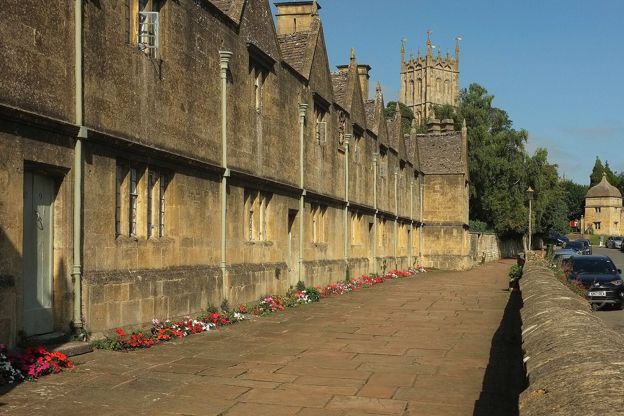
Almshouses, Chipping Campden
Sight · Historic building · Chipping Campden
Twelve almshouses on Church Street in Chipping Campden, built in 1612 for Sir Baptist Hicks at a cost of £1,000 on an I-shaped plan said to honour James I, and still homes for older people. Grade I; seen from the street.
-
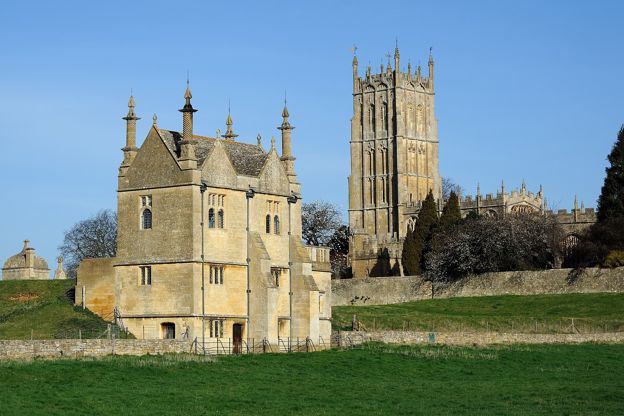
Old Campden House, Chipping Campden
Sight · Historic building · Chipping Campden
The lodges, gateway and two banqueting houses that survive of Sir Baptist Hicks's great house beside St James's in Chipping Campden, burned by its own Royalist garrison in 1645. The banqueting houses are Landmark Trust holiday lets; the grounds open only on occasional open days.
-
St James's Church, Chipping Campden
Sight · Church · Chipping Campden
Chipping Campden's wool church at the end of Church Street: a soaring fifteenth-century tower, William Grevel's brass of 1401, Sir Baptist Hicks's marble tomb and a medieval cope and altar hangings. Grade I, open to visitors most days.