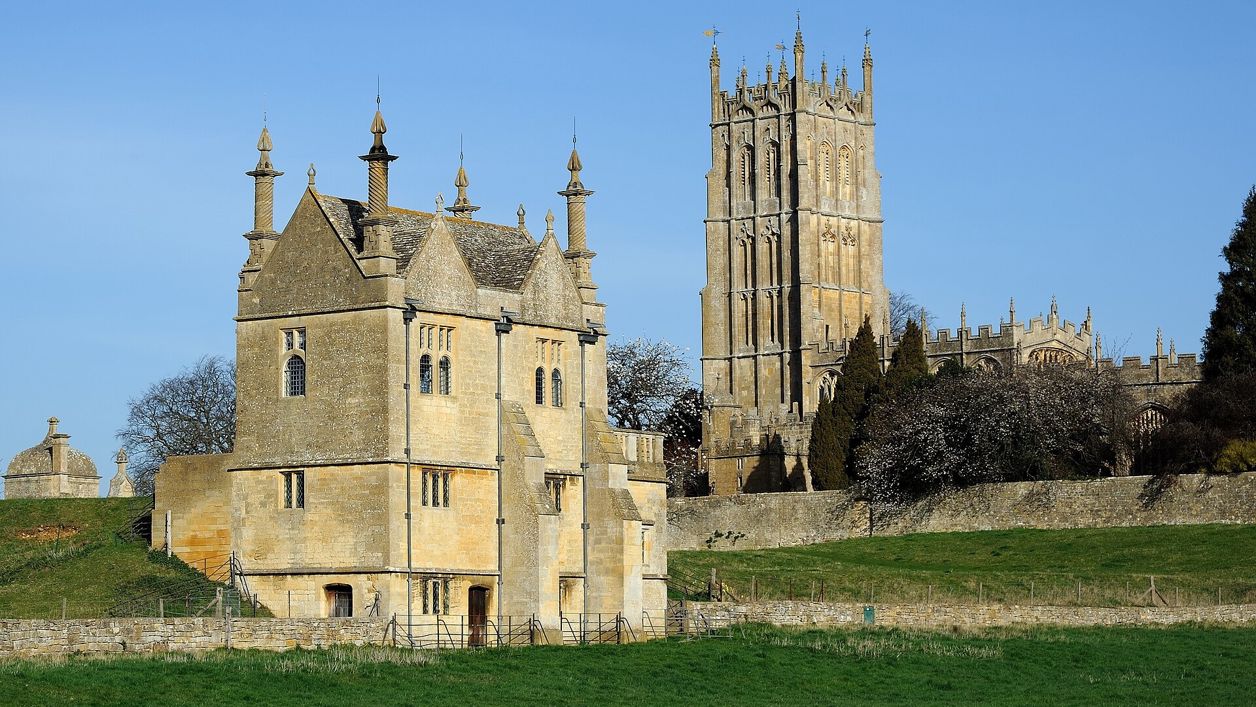
Saffron Blaze, CC BY-SA 3.0, via Wikimedia Commons
Old Campden House, Chipping Campden
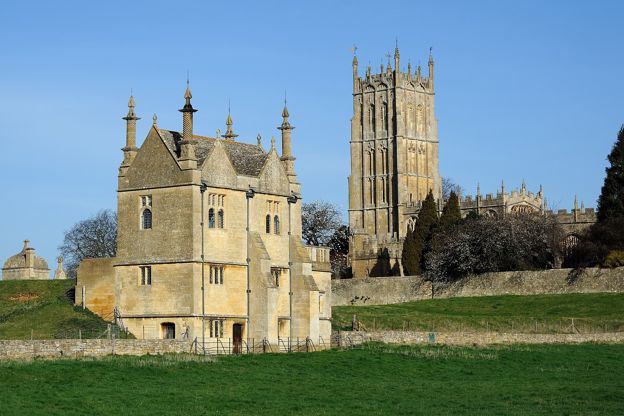
The lodges, gateway and two banqueting houses that survive of Sir Baptist Hicks's great house beside St James's in Chipping Campden, burned by its own Royalist garrison in 1645. The banqueting houses are Landmark Trust holiday lets; the grounds open only on occasional open days.
Historic building
Chipping CampdenOld Campden House is the site of the mansion Sir Baptist Hicks built beside St James's Church in Chipping Campden from about 1613. The Royalist garrison burned it in 1645, and only its gate lodges, its gateways, a small building called the Almonry and two ornate banqueting houses survive. The site is a scheduled monument, and the lodges and banqueting houses are listed.
History
Campden House stood for little more than 30 years. Hicks, a London mercer who grew rich lending to James I and his court, had bought the manor of Campden by 1610, and the Landmark Trust's history says the house was not begun before 1613; Parks and Gardens UK records that it cost £29,000 to build and £15,000 to furnish. It had an elaborate formal garden, with a banqueting house at each end of a broad terrace. Hicks died in 1629, and the manor passed down the Noel family from his daughter Juliana, who had married Edward Noel in 1605.
The fire of 1645
In the Civil War the house became a garrison. The history society records that in January 1645 Colonel Henry Bard brought about 300 Royalist troops into Campden and began to fortify the house. When the garrison left for Evesham in May, it set the house on fire, apparently on the orders of Prince Rupert, and the house burned to the ground. It was never rebuilt. Over the years its shell was raided for building stone, some of it reddened by the flames, and the stables were made into a house known as the Court House. Tradition says Lady Juliana lived there, which is how her gateway got its name.
The Landmark Trust
The two banqueting houses were later adapted as homes for the estate steward and, by the early eighteenth century, a fruit farmer. In 1987 Lady Maureen Fellowes and her husband Peregrine leased the East Banqueting House and the lodges to the Landmark Trust, and in 1998 they passed the West Banqueting House, the Almonry and the rest of the site to its care. The Trust opened the East Banqueting House as a holiday let in the autumn of 1990, after repairs that won an RICS conservation award in 1991, and the West Banqueting House and the Almonry in the summer of 2003. The artist F L Griggs, who saved Dover's Hill for the National Trust, repaired the lodges in about 1930 and supplied the wrought-iron gates.
What to look for
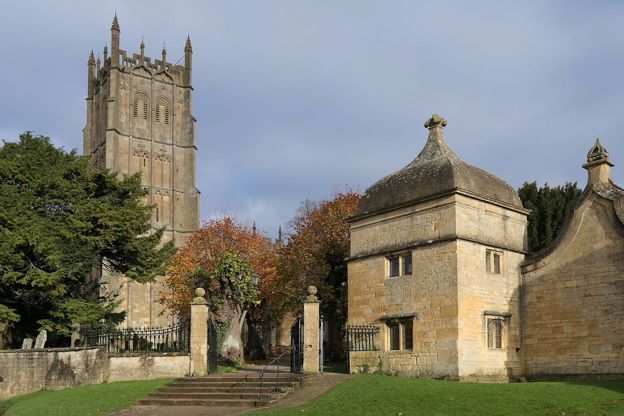
From Church Street you see the entrance Hicks built: two square lodges of two storeys under ogee-shaped stone domes, joined to a central gateway by shaped screen walls, with a pediment and a coat of arms over the arch. Behind them, the open ground where the house stood still shows the earthworks of the raised walks of the early seventeenth-century garden.
The East Banqueting House, the more elaborate of the two, has pierced strapwork parapets, corner pinnacles and spiral chimneys, in a fretted, Flemish-inspired style; Historic England calls it a rare and important survival of early seventeenth-century country house life. The West Banqueting House has barley-sugar chimneys and fine plasterwork inside. Lady Juliana's Gateway, at the end of the site, is reached across a vaulted stone bridge.
Visiting
The lodges and gateway can be seen from Church Street at any time, next to the church. The banqueting houses are holiday lets, so the grounds are private except on the Landmark Trust's occasional open days; check the Trust's website for the next dates and whether to book. Lady Juliana's Gateway can be seen from the footpath across the fields on the south side of the town.
Getting there
By car, park in Back Ends, where the Cotswolds National Landscape asks walkers to park, or in the Market Square car park on the High Street (GL55 6AW), which is free for 20 minutes and then charges from 7am to 7pm every day by card or phone, no cash. Walk along to Church Street and down to the church, about 600m from the Market Hall. Stagecoach buses 1, 1A, 2 and 2A stop in the town between Stratford-upon-Avon and Moreton-in-Marsh station.
On foot, Chipping Campden from Broad Campden, a 3.3-mile (5.3km) loop, passes Lady Juliana's Gateway on the way in and comes back by the lodges and the church.
Nearby
St James's Church, where Hicks and Juliana have their monuments, is beside the lodges, and Court Barn, the museum of Arts and Crafts in Campden, is beside them. Hicks's almshouses are on the way back up Church Street, past the Eight Bells, and his Market Hall is in the High Street. Our guide to Chipping Campden covers the town, and our story on country houses and castles of the Cotswolds the houses that did survive.
Walks past Old Campden House, Chipping Campden
-
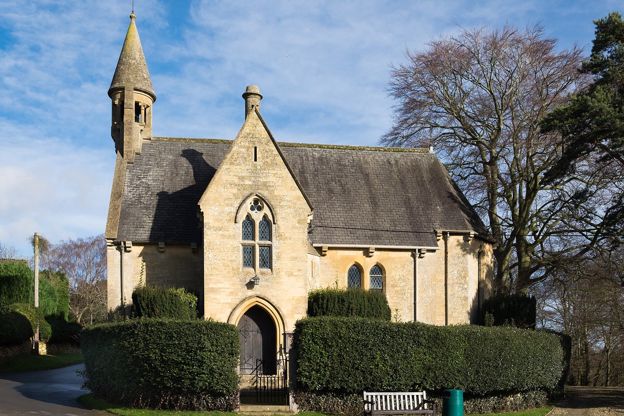
Chipping Campden from Broad Campden
Walk · Starts in Chipping Campden · 1 hr, 15 mins · Circular · Dog-friendly
A 3.3-mile (5.3km) circular walk from St Michael's church in Broad Campden, easy and mostly level, in about an hour and a quarter. It draws a figure of eight over the fields to Lady Juliana's Gateway, along Chipping Campden's High Street, by St James's and back.
-
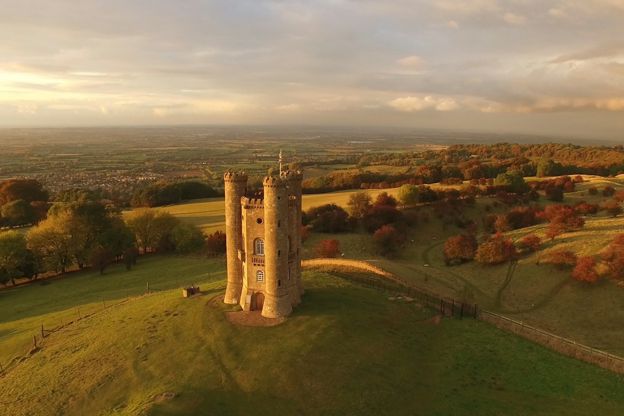
The Cotswold Way
Walk · Dog-friendly
The Cotswold Way is a 102-mile (164km) National Trail walk from Chipping Campden to Bath along the escarpment, in 15 sections; the official guidebook suggests seven to ten days, and its frequent steep climbs make it hard going.
-
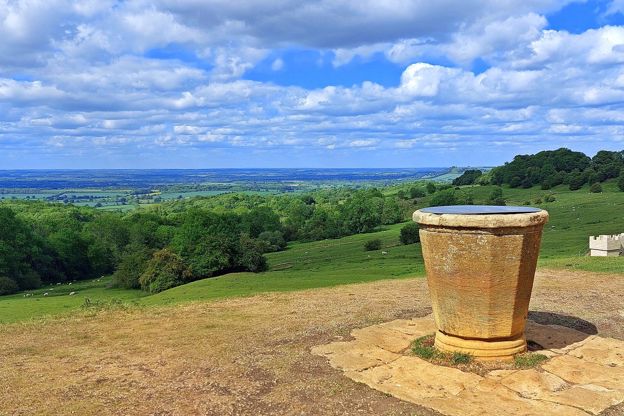
Chipping Campden and Dover's Hill
Walk · Starts in Chipping Campden · 3 hrs, 30 mins · Circular
A 4.5-mile (7.2km) circular walk from the Market Hall in Chipping Campden, two and a half to three and a half hours, moderate with steep sections. It climbs the Cotswold Way to Dover's Hill, home of the Olimpicks, and drops through Lynches Wood; a 3-mile version skips the climbs.
Stay and eat near Old Campden House, Chipping Campden
-
Court Barn Museum
Museums and galleries · Chipping Campden
Chipping Campden's museum of craft and design, telling the story of Ashbee's Guild of Handicraft and the makers who followed, with half price for bus passengers.
Rainy days · Car-free
Verified Oct 2026
-
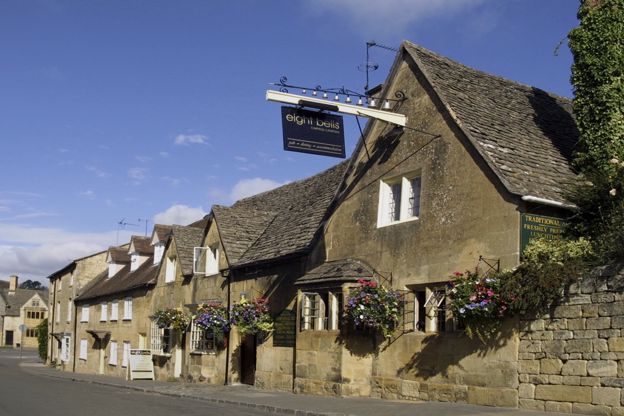
The Eight Bells Inn
Inn · Chipping Campden
A pub with six rooms on Church Street, Chipping Campden, serving lunch and dinner, on Church Street.
Verified Nov 2026
-
Bantam Tea Rooms
Cafes and tearooms · Chipping Campden
Tea rooms with rooms on the High Street in Chipping Campden, open every day from 9.30am to 5pm.
Verified Oct 2026
Stories about Old Campden House, Chipping Campden
-
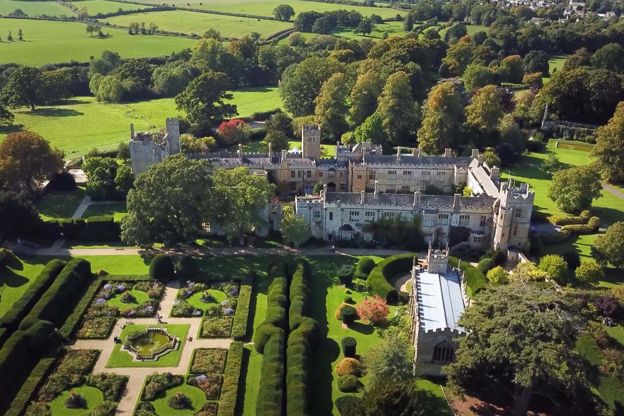
Country houses and castles of the Cotswolds
Story · Guides · 11 minute read
Blenheim, Sudeley, Berkeley, Snowshill, Chastleton, Stanway, Kelmscott, Rodmarton, Dyrham, Lacock and the ruins: the Cotswolds' great houses and castles, who built them, when they open, and which suit children, gardeners or a day by train.
-
The Civil War in the Cotswolds
Story · History · 9 minute read
The storming of Cirencester and the battle of Lansdown in 1643, Sudeley Castle besieged and slighted, Campden House burned, the last battle of the first war at Stow in 1646, the Levellers at Burford and Chastleton's hidden Royalist, with where to see each.
More sights to see
-
St James's Church, Chipping Campden
Sight · Church · Chipping Campden
Chipping Campden's wool church at the end of Church Street: a soaring fifteenth-century tower, William Grevel's brass of 1401, Sir Baptist Hicks's marble tomb and a medieval cope and altar hangings. Grade I, open to visitors most days.
-
Almshouses, Chipping Campden
Sight · Historic building · Chipping Campden
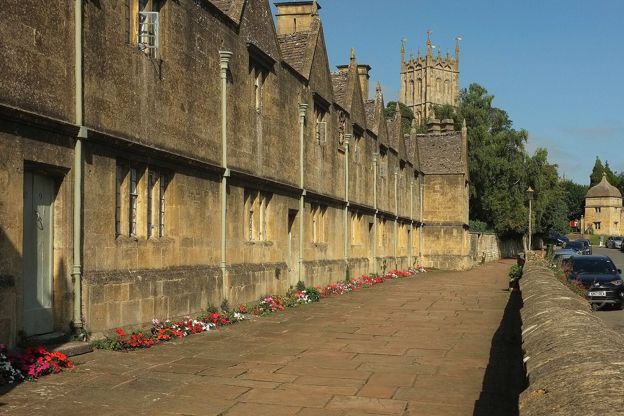
Twelve almshouses on Church Street in Chipping Campden, built in 1612 for Sir Baptist Hicks at a cost of £1,000 on an I-shaped plan said to honour James I, and still homes for older people. Grade I; seen from the street.
-
Market Hall, Chipping Campden
Sight · Historic building · Chipping Campden
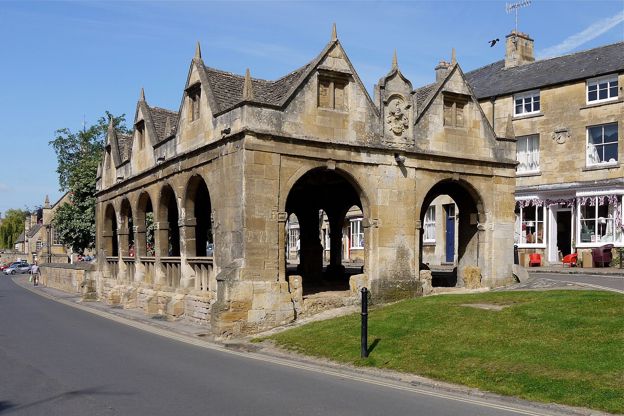
The open arcade of 1627 in the middle of Chipping Campden's High Street, built by Sir Baptist Hicks as a sheltered market for butter, cheese and poultry, saved from sale to America in the 1940s and now the National Trust's. Grade I; the Cotswold Way starts beside it.