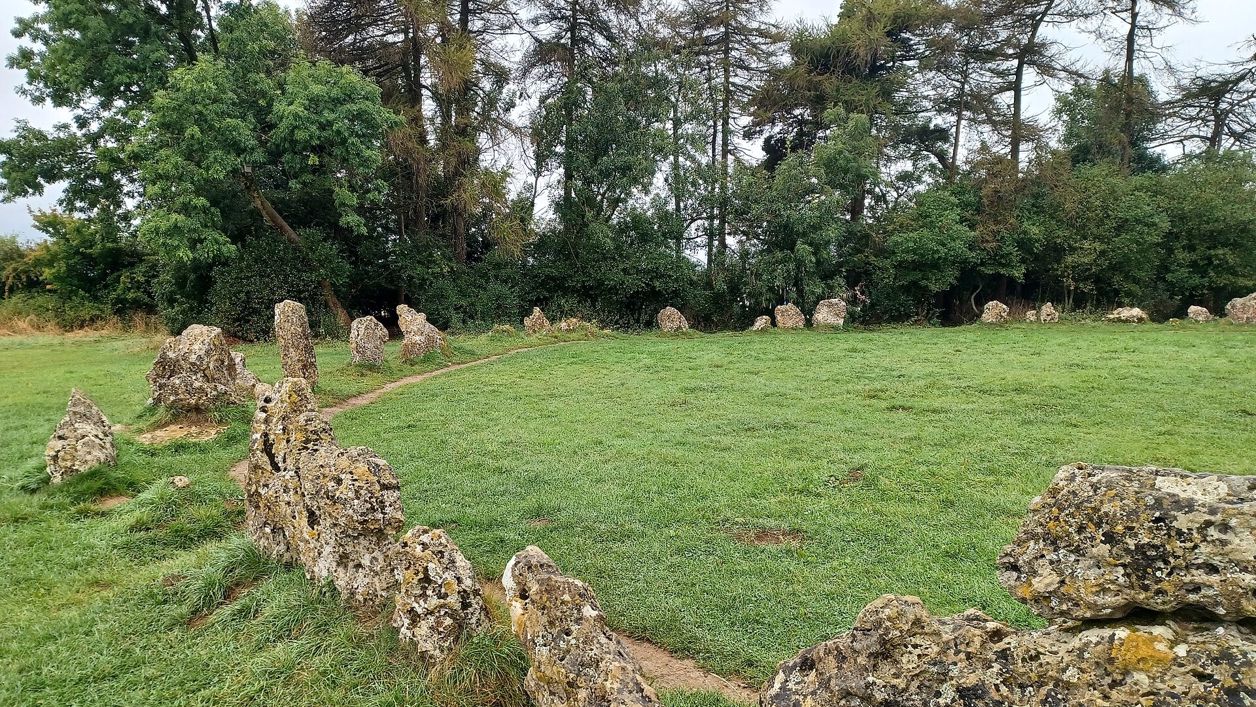
Simon Burchell, CC BY-SA 4.0, via Wikimedia Commons
The Rollright Stones
The Rollright Stones are three prehistoric monuments on a ridge on the Oxfordshire and Warwickshire border, built over nearly 2,000 years: the Whispering Knights burial chamber of about 3800 BC, the King's Men circle of about 2500 BC and the King Stone. Open daily; small fee.
Hill fort or barrow
The Oxfordshire CotswoldsThe Rollright Stones stand on a ridge on the border of Oxfordshire and Warwickshire, at the northern edge of the Oxfordshire Cotswolds, above the village of Long Compton. There are three monuments, built across nearly 2,000 years: the Whispering Knights, an early Neolithic burial chamber; the King's Men, a stone circle of about 2500 BC; and the King Stone, a single standing stone of the Bronze Age. A small charity run by volunteers, the Rollright Trust, owns and looks after them.
History
People were on this ridge long before the stones went up: excavation near the King Stone found flint debris of the late Mesolithic, more than six thousand years ago. All three monuments are made of boulders of the local oolitic limestone, probably gathered within 500m of the site.
The Whispering Knights
The oldest monument is a portal dolmen, a burial chamber of about 3800 to 3500 BC, which would make it one of the earliest funerary monuments in Britain. It stands about 400m east of the circle. A piece of human bone washed out of the chamber has been dated to about 1700 BC, and pottery of the early Neolithic, the Beaker period and the early Bronze Age was found nearby, so the tomb was venerated for many centuries.
The King's Men
The circle was raised around 2500 BC, at the end of the Neolithic. It is a ring about 31m across, and there are seventy-odd weathered stones today; the Trust thinks there may once have been about 105, standing shoulder to shoulder. Tradition says stones were carted off, for bridges among other things, which would explain most of the gaps. A portal entrance marked by two stones just outside the ring faces the tallest stone.
The King Stone
Across the lane, the King Stone was probably put up around 1500 BC, not as an outlier of the circle but as a marker for a burial ground beside it: in the 1980s excavators found cremations near a Bronze Age round cairn 17m across, one dated to about 1880 to 1746 BC. Later the ridge held the ditches of a late Bronze Age or early Iron Age field system, an Iron Age enclosure of about 400 to 100 BC and a Roman farm, and a Saxon cemetery of about AD 700 came to light in nineteenth-century quarrying; in 2015 excavators found the grave of a young woman buried with a bronze pan.
Writers, antiquarians and protection
The stones are first mentioned in writing in the late twelfth century, in an account of the wonders of Britain that says great stones in Oxfordshire were set out as if by the hand of man, and that local people called the place Rollendrich. Ralph Sheldon's woven maps of about 1590, made as wall hangings, show them, William Camden published the first drawing in his Britannia of 1607, and William Stukeley studied the site in the eighteenth century. The stones were taken into state protection in 1883, soon after the first law for ancient monuments; the owner then stood the fallen stones of the circle back up, not always in exactly the right places, and railings went round the King Stone and, in 1894, the Whispering Knights.
The legends
The best-known story explains all three monuments at once: a king and his army, outwitted by a witch on the ridge, were turned to stone, the king as the King Stone, his men as the circle and his treacherous knights as the Whispering Knights. In the story a mound hid Long Compton from the king's sight; the Trust says the rise is a natural knoll, which a Bronze Age cairn was later built on, not a long barrow. The stones of the circle are, as the Trust puts it, famously uncountable. Pieces of the King Stone were chipped off as charms, by cattle drovers in the legend and by nineteenth-century souvenir hunters in fact, which is why it is now so oddly shaped. Our story on ley lines and the Rollright Stones follows the modern folklore.
What to see
Start at the King's Men, beside the lane: walk round the ring and try counting. The stones are weathered into strange, pitted shapes, and the tallest faces the entrance. Cross the lane to the King Stone, which the Trust likens to a seal balancing a ball on its nose, with the attachment holes of its old railings still visible. Then walk about 400m east to the Whispering Knights, four upright stones and a fallen capstone leaning together, said to be the knights plotting against their king, or praying. The circle is a Dark Sky Discovery Site, used by the Chipping Norton Amateur Astronomy Group as a field observatory, and the stones are open at night for stargazing.
Visiting
The Rollright Stones are open every day of the year. The Trust asks a small fee to pay for looking after the site: £2 for adults and £1 for children aged 7 to 16 when we checked in October 2026, with under 7s free according to English Heritage, paid online, by QR code on site, in cash at the honesty box in daylight or to a warden on busy weekends, and valid all day, so you can come and go. Do not sit or climb on the stones; keep dogs on leads and out of the circle. The Trust says the paths and gateways suit wheelchairs, mobility scooters and pushchairs, and there are benches by the King's Men and the Whispering Knights. There are no toilets or other facilities on site; the Trust points visitors to Wyatts Garden Centre, about a mile east towards Great Rollright, for toilets and a café. Groups, school visits, celebrations and filming must be booked with the Trust, and drones are not allowed.
Getting there
The stones are on the minor road between the A3400 and the A44, north of Chipping Norton and south of Long Compton (OX7 5QB). There is no car park: two small laybys on the lane beside the King's Men, about 18 spaces in all by English Heritage's count, fill quickly, so do not use them as the start of a long walk, and do not leave anything on display in the car. No bus passes the stones; the Trust says the driver of Stagecoach's 50, between Stratford-upon-Avon and Chipping Norton, may stop at the crossroads at the top of Long Compton Hill, about half a mile east. On foot, Salford and the Rollright Stones climbs to all three from Salford, near Chipping Norton.
Nearby
The Red Lion at Long Compton is the nearest pub, Chipping Norton has more pubs and cafés, and our guide to the Oxfordshire Cotswolds covers the towns round about. West across the Evenlode valley is Adlestrop, where the railway sign and bench of Edward Thomas's station hang in the bus shelter, and St Andrew's Church at Kingham. For more of the Cotswolds' prehistory, the Neolithic long barrow of Whitfield's Tump and the pierced standing stone called the Long Stone are near Minchinhampton, and our story Pagan Cotswolds? What the record says about old customs sorts the evidence from the legend.
Walks past The Rollright Stones
-
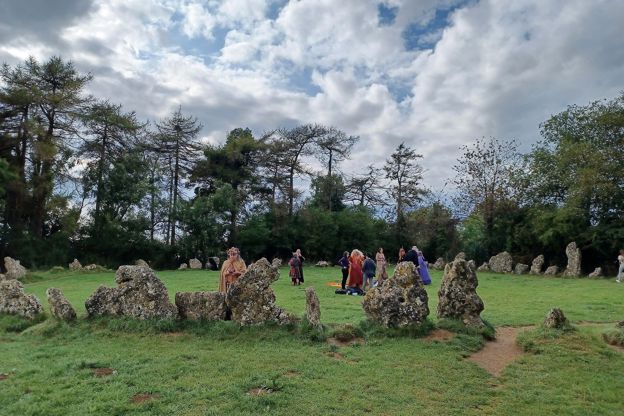
Salford and the Rollright Stones
Walk · Starts in the Oxfordshire Cotswolds · 2 hrs, 30 mins · Circular · Dog-friendly
A 5-mile (8km) circular walk from the green at Salford, moderate and about two and a half hours, with stiles: up bridleways and field paths to the Whispering Knights, the King Stone and the King's Men stone circle, then down through Little Rollright and back.
Stay and eat near The Rollright Stones
-

Whichford Pottery
Tours and experiences · Shipston-on-Stour
A working pottery in the village of Whichford, near Shipston-on-Stour, making hand-thrown frostproof terracotta flowerpots since 1976, with a stockyard, a shop, a café and courses.
Verified Oct 2026
Stories about The Rollright Stones
-
Clarkson's Farm: visiting Diddly Squat and the Farmer's Dog
Story · Guides · 7 minute read
Where Clarkson's Farm is made, what you can and cannot see at Diddly Squat Farm Shop near Chadlington and at the Farmer's Dog near Burford, and how to visit without the worst of the queues.
-
Ley lines and the Rollright Stones
Story · Strange Things · 5 minute read
Alfred Watkins saw straight old tracks across the English landscape in 1921. Later writers made them lines of mystic energy. Here is what is actually known.
More sights to see
-
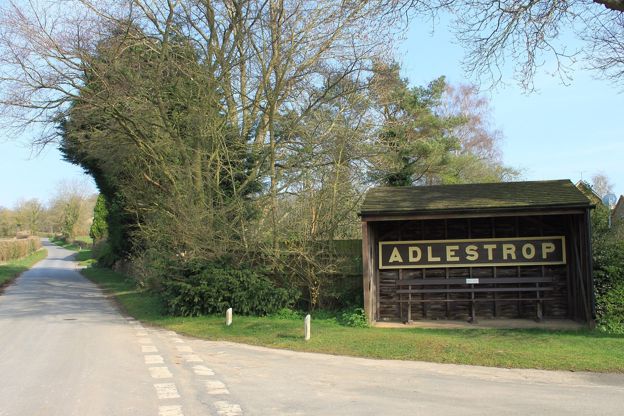
Adlestrop railway sign and seat
Sight · Monument · The Oxfordshire Cotswolds
The Great Western Railway sign and bench from Adlestrop's lost station stand in the village bus shelter, where they were set up in the early 1970s. Edward Thomas's train stopped here in June 1914, and his poem Adlestrop made the name famous. Grade II; free to see.
-
St Andrew's Church, Kingham
Sight · Church · Kingham
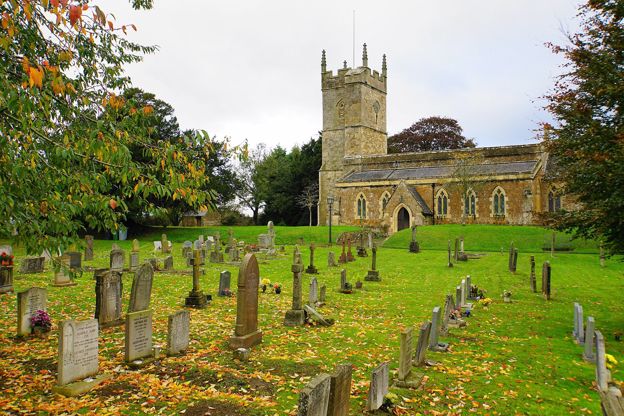
Kingham's ironstone church of the fourteenth and fifteenth centuries, with a pinnacled tower, a nave roof dated 1774, an Elizabethan brass in the Easter Sepulchre and the old rectory of 1688 next door. Grade II*.
-
Whitfield's Tump, Minchinhampton Common
Sight · Hill fort or barrow · Minchinhampton
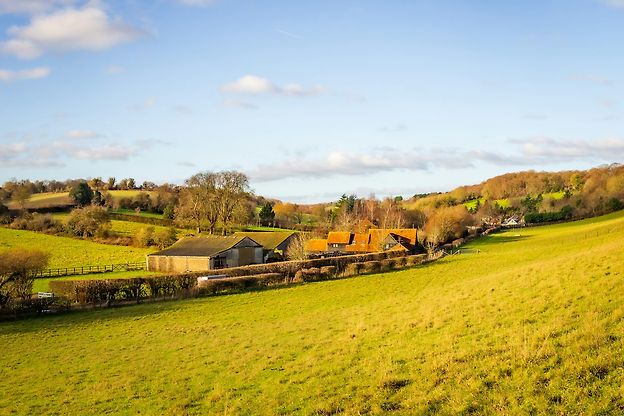
Whitfield's Tump is a Neolithic long barrow on Minchinhampton Common, a low mound 26m long where early farmers buried their dead, named from the tradition that the preacher George Whitefield spoke from it in 1743. A scheduled monument on free National Trust land.