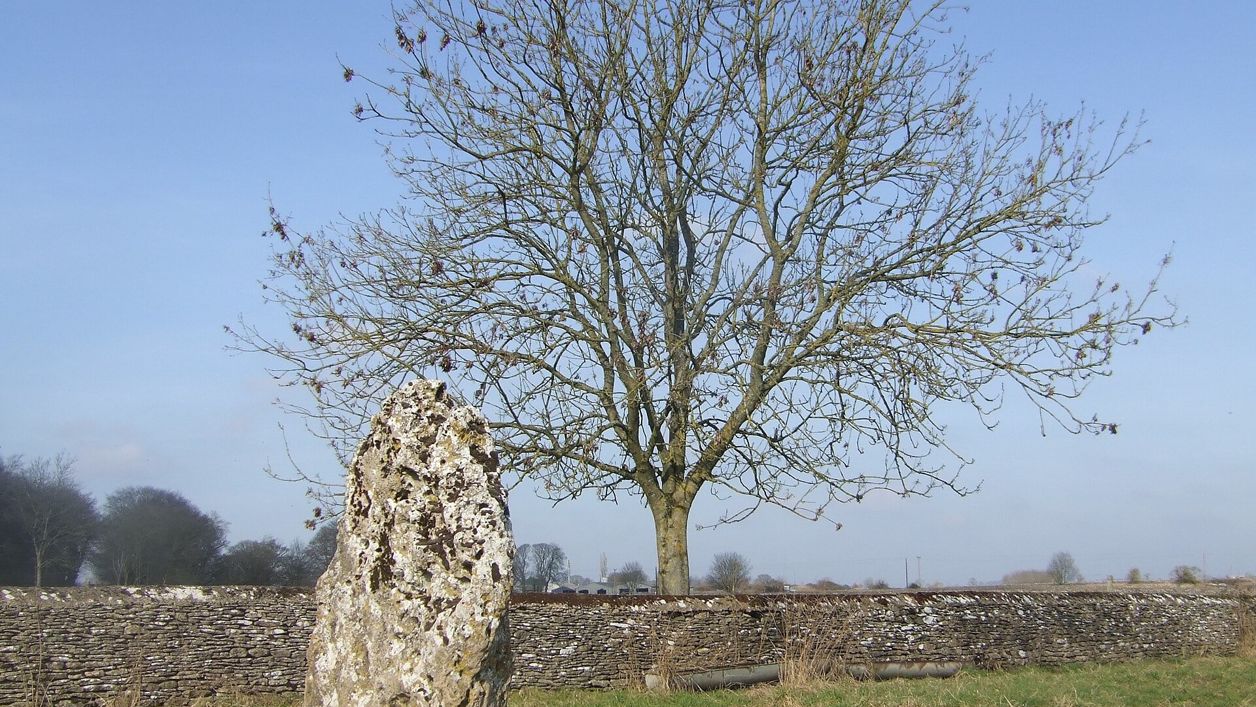
John M, CC BY-SA 2.0, via Wikimedia Commons
The Long Stone, Minchinhampton
The Long Stone is a prehistoric standing stone in farmland south-east of Minchinhampton: a slab of oolite 2.1m high, pierced by holes that give it its local name, the Holey Stone. Tradition says children were passed through them as a cure for rickets. A scheduled monument.
Hill fort or barrow
MinchinhamptonThe Long Stone is a single upright slab of oolite standing in a field about 1.4km south-east of Minchinhampton, on the plateau south-east of the town. It is prehistoric, up to 2.1m tall, and pierced by holes, which give it its local name, the Holey Stone. It is a scheduled monument.
History
The stone is a standing stone, a kind of monument Historic England dates from the Late Neolithic to the end of the Bronze Age, raised for reasons that are now lost: as markers, memorials or meeting places, or for ritual. Standing stones are rare nationally and cluster in a few parts of England, the Cotswolds among them. This one survives well, and the ground at its foot may still hold evidence of how and when it was put up.
Antiquarians took a different view. They thought the Long Stone had been part of the stone chamber of a long barrow, with other stones nearby that have since been moved or scattered. A recent geophysical survey found no trace of such a chamber, and Historic England records it as a standing stone.
The Holey Stone
The holes gave the stone a reputation. Historic England notes an older local tradition that a child with rickets could be cured by being passed through one of them.
What to see
The stone is a broad, flat slab, up to 1.7m wide and only 0.4m thick, set edge-on in the ground. At least two large holes and several smaller ones go right through it, and from the right angle you can see the field beyond through them. The setting is part of the point: a wide, gently rolling plateau with long views, typical of where such stones were raised.
Visiting
The Long Stone is on private farmland and is seen from outside the field, from the minor road and the footpath beside it, at any time and for nothing. Do not climb into the field or onto the stone, which is protected as a scheduled monument. The road is narrow with no pavement, so stand well in on the verge. Late afternoon light, low across the plateau, shows the holes best.
Getting there
There is no parking at the stone. Park in Minchinhampton, where the Friday Street car park (GL6 9JL) is the nearest council car park, and walk out south-east along the lanes, about 1.4km. The Stagecoach West 620 bus from Stroud to Tetbury stops in Market Square seven times a day, Monday to Saturday, with no Sunday service. None of our walks passes the stone yet.
Nearby
In the town, Holy Trinity Church and the Market House are a short walk from each other. West of the town, Minchinhampton Common holds the Iron Age bank of the Bulwarks and the Neolithic long barrow called Whitfield's Tump, so one morning can take in monuments from the Neolithic to the Iron Age. Our guide to Stroud and the Five Valleys covers the country round about.
Stay and eat near The Long Stone, Minchinhampton
-
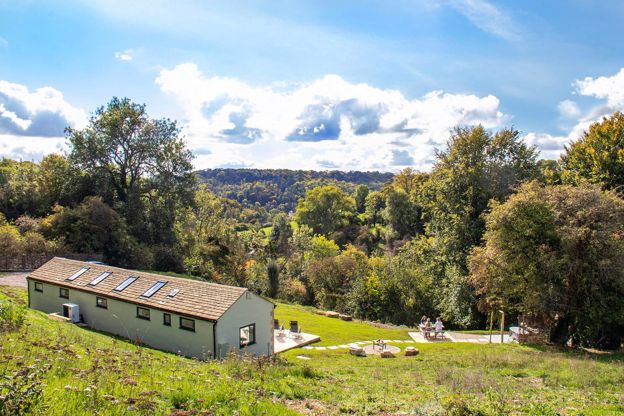
Wild View
Self-catering · Minchinhampton
A two-bedroom lodge for four in three acres of meadow at the end of a lane below Minchinhampton, with an outdoor bath, a fire pit and dogs welcome.
Dog-friendly · Family-friendly · Walker-friendly
Verified Oct 2026
-
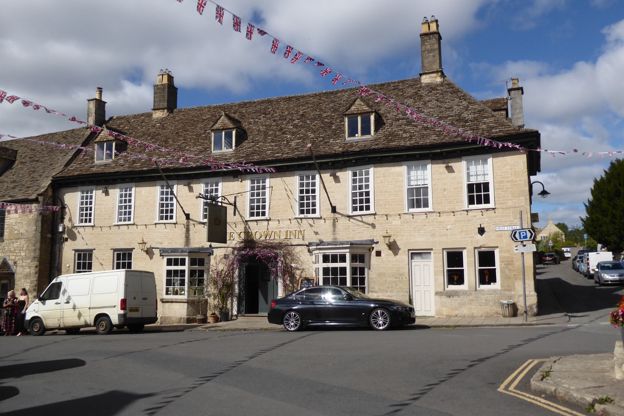
The Crown Inn, Minchinhampton
Pubs · Minchinhampton
A Young's pub in the old coaching inn on Minchinhampton's High Street, opposite the Market House, with a hidden garden, Sunday roasts and a monthly quiz.
Verified Nov 2026
-
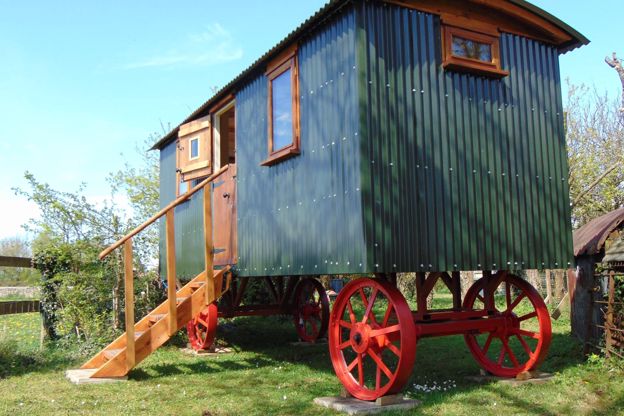
Burnt Ash Farm
Glamping · Minchinhampton
A small family-run stables a mile east of Minchinhampton with shepherd huts in an orchard and a small campsite for five caravans or motorhomes.
Family-friendly · Walker-friendly
Verified Nov 2026
More sights to see
-
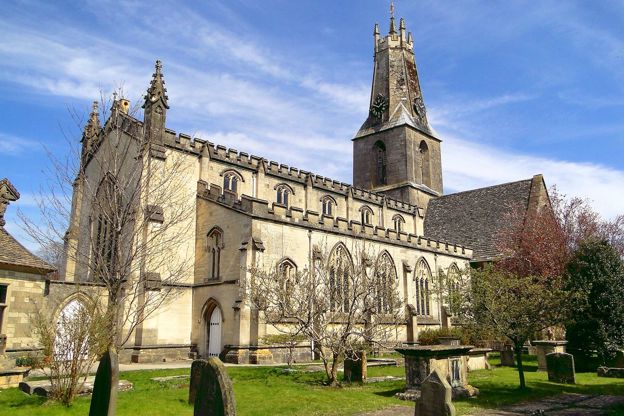
Holy Trinity Church, Minchinhampton
Sight · Church · Minchinhampton
Holy Trinity is Minchinhampton's Grade I parish church, known for its fourteenth-century tower whose spire was cut short in 1563 and crowned with a stone coronet, a south transept lit by a great rose window, and the grave of the astronomer James Bradley.
-
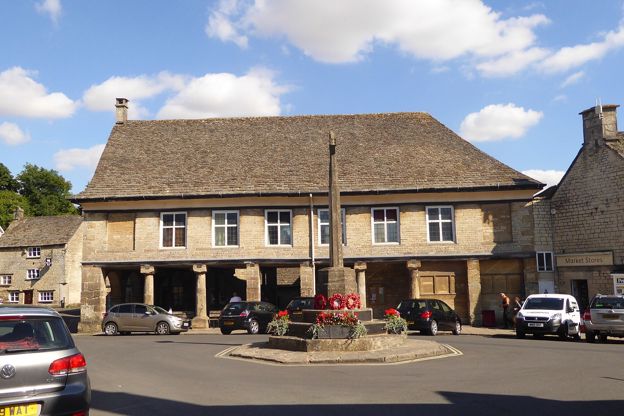
Market House, Minchinhampton
Sight · Historic building · Minchinhampton
Minchinhampton's Market House was built in 1698 by the lord of the manor, Philip Sheppard, for the wool and yarn trade: an open arcade on stone piers with a hall above. Listed Grade II*, it still holds a country market on Wednesday mornings.
-
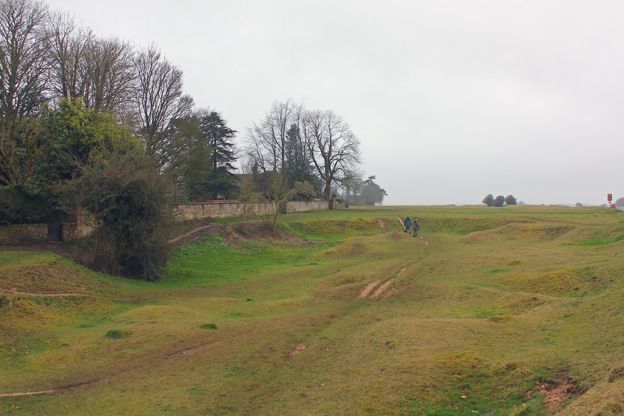
The Bulwarks, Minchinhampton
Sight · Hill fort or barrow · Minchinhampton
The Bulwarks is a Late Iron Age bank and ditch that sweeps across Minchinhampton Common north and north-west of the town: a bank 10m to 12m wide with a stone face, dated by pottery found in the 1937 excavation. It lies on free National Trust common land.