The Daffodil Way at Dymock: wild daffodils in the Leadon Valley
Every spring the fields and woods around Dymock turn yellow with wild daffodils. The Daffodil Way walks you through them, 10 miles from church to church, just west of the Cotswolds.
· 8 minute read
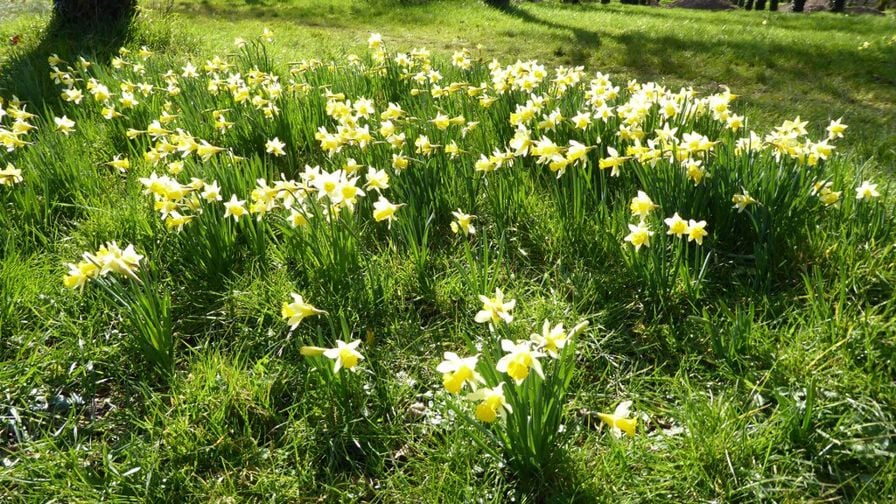
The Daffodil Way is a circular footpath of about 10 miles around Dymock, a small village in the Leadon Valley between Ledbury and Newent, and from March into April it takes you through some of the best wild daffodil country in England. The flowers grow in their thousands under the oaks, along the field edges and in the old orchards, and in the churchyards the route passes. The Windcross Paths Group made the route in the late 1980s and still looks after it.
To be clear about the map: Dymock is not in the Cotswolds. It lies across the Severn Vale from the Cotswold hills, in the Forest of Dean district, closer to the Malverns. But it is an easy day out from Gloucester or Tewkesbury, and for wild daffodils nowhere in the Cotswolds comes close, which is why the old Cotswolds Info sent its readers here.
When do the wild daffodils flower at Dymock?
In March and April. Plantlife gives March and April as the wild daffodil's season. The Gloucestershire Wildlife Trust gives March to May as the best time for its daffodil meadows. Kempley holds its daffodil weekend in mid-March (14 and 15 March in 2026), which is a fair guide to when the show is at its height. A mild winter brings it forward, and a cold one holds it back.
This is the native wild daffodil, Narcissus pseudonarcissus, also called the Lent lily. It is smaller than a garden daffodil, with pale petals around a deep yellow trumpet and grey-green leaves. Plantlife says the area around Newent and Dymock is known as the Golden Triangle for them. The flowers were once a crop: Kempley's own history says that years ago local children picked them, and they went from Gloucester to London by train. Today the Wildlife Trust asks visitors not to pick them, and it is against the law to dig up wild plants without the landowner's permission.
Walking the Daffodil Way
The route is about 10 miles through woods, orchards and meadows, and the Friends of the Dymock Poets say it passes three churches. It is waymarked all the way round. Many of its stiles have been replaced with kissing gates, and Kempley's walkers describe a resurfaced path through the woods there. The Windcross Paths Group (opens in a new tab), which works with the county's rights of way team and the Dymock and Kempley parish councils, sells the route leaflet for about £2. You can order it from the group by email, or buy it at St Mary's Church in Dymock or in shops in Ledbury. For a map, Kempley suggests OS Explorer 189 and 190.
Allow most of a day, five hours or so of walking with time to stop. The ground is low farmland and woodland, and the field paths are muddy after rain, so wear boots. The route crosses farmland, so keep dogs on a lead near livestock and close the gates behind you.
For a short walk, Dymock Forest (opens in a new tab) has two marked trails from Forestry England's Queenswood car park (GL18 2BN), which is free and open from dawn to dusk: the Lake Walk of 2.5km and the Princes Walk of 1.5km. Parts of the forest are a Site of Special Scientific Interest, noted for its wild daffodils.
The daffodil meadows you can visit for free
The Gloucestershire Wildlife Trust has three small reserves in the valley, all free and open to visitors. Vell Mill Daffodil Meadow (opens in a new tab) is half a mile east of Dymock (GL18 2DG): a hectare of meadow behind a gate, with parking for about four cars, best from March to May. Dogs are allowed on a lead. The hay is cut in July, and an orchard was planted there in 2011.
Gwen and Vera's Fields (opens in a new tab), near Oxenhall about 2 miles north-west of Newent (GL18 1RW), is another hectare of daffodils. It has no dogs at all, and the Trust asks you to keep to the path round the edge and not to make for the River Leadon. There is limited parking at the gate, or use Forestry England's Shaw Common car park. Ketford Banks (opens in a new tab), a small, steep sandy bank in the Leadon valley that the Trust bought in 2010, is open access and best from March to May.
Older guides send you to Betty Daw's Wood as a Wildlife Trust reserve. It no longer is one: the Trust no longer looks after it, and Forestry England now manages it as part of the Dymock woods.
Kempley: the daffodil weekend and two churches
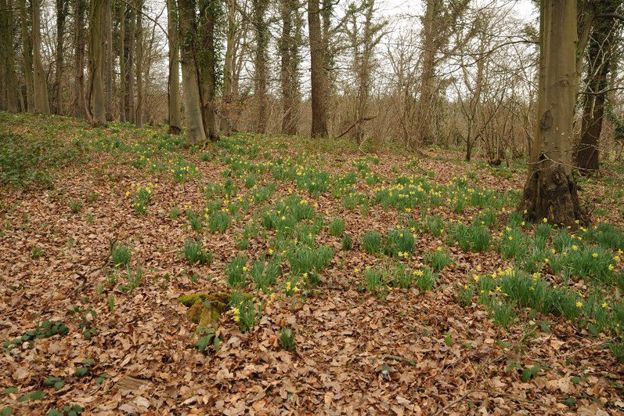
Kempley, the next parish, has made the flowers its own. Its Daffodil Weekend (opens in a new tab) in mid-March has guided walks from St Edward's Church, teas in the village hall and exhibitions in both churches, with donations going to the church and the village hall. Dogs are welcome on a lead, and the village gives GL18 2BP for a sat nav. Its site posts the dates and walk times each spring.
St Mary's Church (opens in a new tab) at Kempley, in the care of English Heritage, has wall paintings in its chancel from the early 12th century and wild daffodils in the churchyard. It is free to go in, with a little free roadside parking opposite (GL18 2AT). English Heritage and the village give different winter opening days, so check before you go between November and February. Kempley's other church, St Edward's, was built in 1902 to 1904 for the 7th Earl Beauchamp, an Arts and Crafts church whose building Randall Wells supervised, with carved stone reliefs he designed.
The Dymock Poets
For a few years before the First World War these fields were full of poets. Lascelles Abercrombie moved to The Gallows at Ryton in 1911, and Wilfrid Gibson to The Old Nail Shop at Greenway in January 1914. Robert Frost came that spring, first to Little Iddens at Leddington and then to The Gallows, and stayed until February 1915. Edward Thomas stayed nearby in April and August 1914, and the two men's walks here led Thomas to write poetry. Rupert Brooke came for two nights in June 1914, and John Drinkwater visited. Together they published four issues of New Numbers, from March 1914 to February 1915. The Friends of the Dymock Poets (opens in a new tab) keep their story at St Mary's Church, Dymock, which has had a permanent exhibition about them since 2006. Two waymarked walks, the Poets' Paths, start from the church; the Friends' site shows a map of them, and the illustrated leaflets are sold locally.
Getting there, parking and lunch
Dymock is on the B4215. Kempley is about 2 miles from junction 3 of the M50, and Ledbury, Newent and Ross-on-Wye are each 5 or 6 miles from it. Without a car, take the train to Ledbury and the DRM 232 bus (opens in a new tab) from the station to Dymock, which stops by St Mary's Church on its way to Newent and Ross. The service is not frequent, so check the timetable for your day before you set out.
To park, use the Queenswood car park in Dymock Forest, the few spaces at Vell Mill, or the roadside by Kempley church, and park with care in the lanes, which are narrow and busy on the daffodil weekend. The Beauchamp Arms (opens in a new tab) in Dymock has been owned by the parish council since 1997. CAMRA's listing shows it closed on Mondays and Tuesdays (read 15 November 2026), so check its Facebook page before planning lunch around it.
More spring flowers in the Cotswolds
In the Cotswolds themselves the daffodils are mostly the garden kind, on the verges and in the churchyards; our guides to the Cotswolds in March and in April say which gardens are open for them. The bluebell woods follow from late April, and the snowdrops come before, in February.
The Cotswolds Info newsletter
Events, new places and the best of the season, about once a month. Unsubscribe at any time.
Read next
-
The Cotswolds in March
Story · Guides · 8 minute read
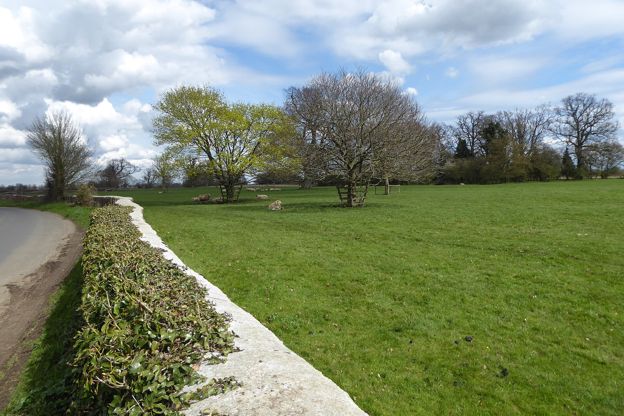
The Cotswolds in March: daffodils, lambs and the gardens reopening, the Cheltenham Festival week to plan around, Mothering Sunday and an early Easter, what opens when, three walks for the first dry days, and a day out from Winchcombe.
-
Bluebell woods in the Cotswolds
Story · Guides · 10 minute read
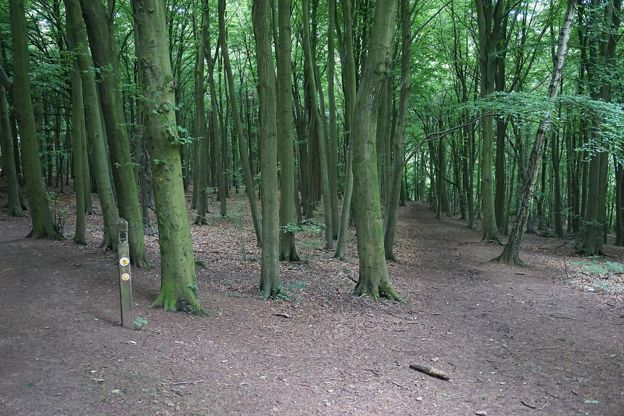
The best bluebell woods in the Cotswolds, from Westonbirt's Silk Wood and Lynches Wood below Dover's Hill to Standish Wood, Frith Wood, Siccaridge Wood and Foxholes: when they flower, who looks after each wood, where to park, the dog rule and the walk that goes through it.
-
When to visit the Cotswolds, month by month
Story · Guides · 13 minute read
The best months to visit the Cotswolds are May, September and October. June to August and the bank holidays are the busiest, January the quietest. Here is the year month by month, with what is in flower, the customs, the weather and what to book ahead.