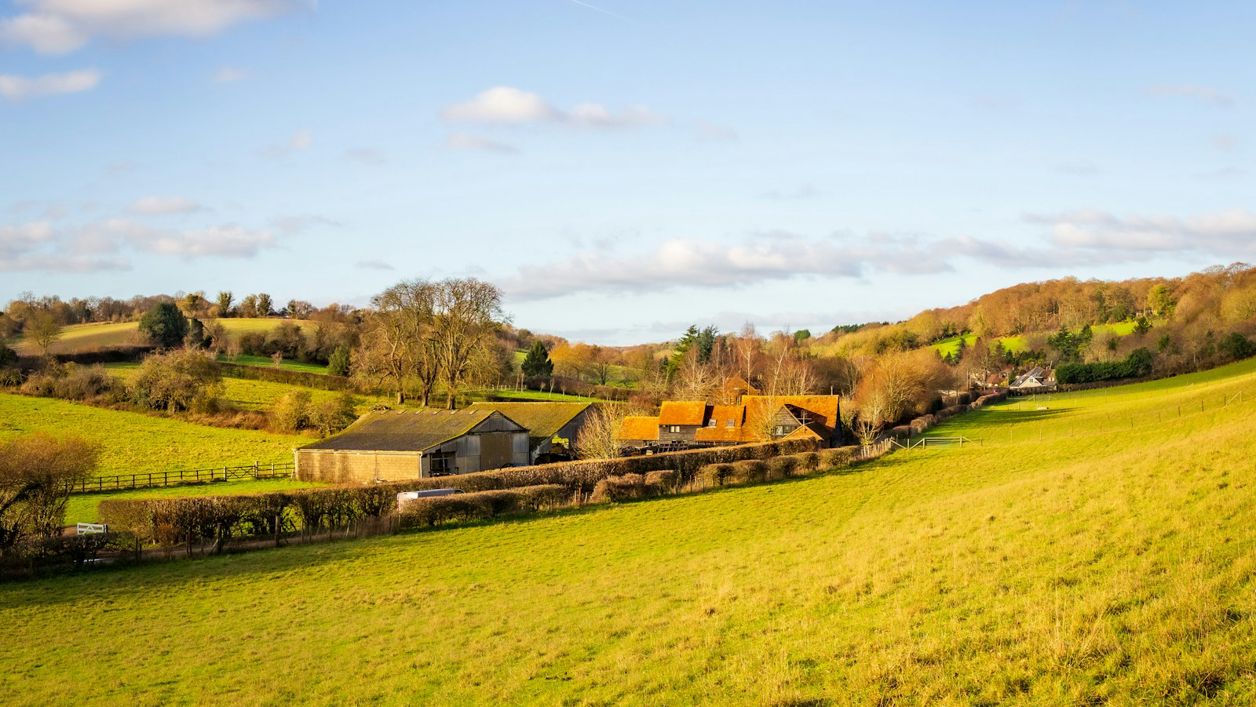
The weather in the Cotswolds, honestly
Month by month from the Met Office's 1991 to 2020 averages for Little Rissington, up on the wold, and Brize Norton in the lowland below: why the tops are colder and windier, when it rains, what snow does to the roads, where the rivers flood and what to pack.
The Cotswolds has a mild, damp climate, a little cooler, wetter and windier than the lowland round it because so much of it is high ground. On the Met Office's 1991 to 2020 averages for Little Rissington (opens in a new tab), the station on the old airfield above Bourton-on-the-Water, July days reach 21.4°C and January days 6.5°C, about 810mm of rain falls in a year on 133 days, and there are 46 nights of air frost. October to January are the wettest months, and May to August the sunniest.
For a lowland comparison we use Brize Norton (opens in a new tab), in the Windrush and Thames lowland south of Burford. The villages along the Cotswold rivers sit somewhere between the two.
Why the tops are colder and windier
The high wolds are about a degree colder than the lowland all year, and windier by half. Over thirty years Little Rissington, the higher station, averaged a daytime high of 13.4°C against 14.6°C, a mean wind of 10.3 knots against 6.7, and about 100mm more rain a year (810mm against 706mm). Frost nights are close, 46 against 44, since cold air sinks into low ground on still nights.
On the ground, a walk across the open wold between Stow-on-the-Wold and Northleach feels colder than the forecast for Cheltenham or Oxford. The valleys of the Coln, the Windrush and the Five Valleys are more sheltered, and slower to clear of frost on winter mornings.
Little Rissington by month: January to June
- January
- 6.5°C by day, 1.1°C at night. 78mm of rain on 13 days, 62 hours of sun, 12 nights of air frost. Brize Norton: 7.7°C and 1.7°C.
- February
- 7.1°C by day, 1.1°C at night. 55mm of rain on 11 days, 83 hours of sun, 10 frosts. Brize Norton: 8.3°C and 1.6°C.
- March
- 9.7°C by day, 2.3°C at night. 54mm of rain on 11 days, 124 hours of sun, 7 frosts. Brize Norton: 10.9°C and 3.0°C.
- April
- 12.8°C by day, 4.0°C at night. 56mm of rain on 10 days, 169 hours of sun, 3 frosts. Brize Norton: 13.9°C and 4.8°C.
- May
- 15.9°C by day, 6.8°C at night. 66mm of rain on 10 days, 202 hours of sun, frost rare. Brize Norton: 17.1°C and 7.6°C.
- June
- 19.0°C by day, 9.7°C at night. 57mm of rain on 9 days, 198 hours of sun. Brize Norton: 20.1°C and 10.5°C.
Little Rissington by month: July to December
- July
- 21.4°C by day, 11.7°C at night. 62mm of rain on 9 days, 220 hours of sun, the sunniest month. Brize Norton: 22.5°C and 12.6°C.
- August
- 20.7°C by day, 11.8°C at night. 65mm of rain on 10 days, 184 hours of sun. Brize Norton: 21.9°C and 12.5°C.
- September
- 17.9°C by day, 9.7°C at night. 64mm of rain on 10 days, 143 hours of sun. Brize Norton: 19.0°C and 10.3°C.
- October
- 13.6°C by day, 7.0°C at night. 84mm of rain on 13 days, 111 hours of sun, the first frost. Brize Norton: 14.8°C and 7.5°C.
- November
- 9.5°C by day, 3.8°C at night. 85mm of rain on 14 days, the wettest month. 73 hours of sun, 4 frosts. Brize Norton: 10.6°C and 4.2°C.
- December
- 6.8°C by day, 1.5°C at night. 83mm of rain on 13 days, 63 hours of sun, 10 frosts. Brize Norton: 8.0°C and 2.0°C.
Our month guides turn these figures into plans, from January, February and March through April, May, June, July, August and September to October, November and December. For the choice of season, read when to visit the Cotswolds.
Snow and the roads over the hills
When snow comes, it closes the lanes before it touches the main roads. Gloucestershire County Council salts a priority network of A and B roads, some main bus routes and roads to hospitals and schools, about 28% of the county's roads, and each run takes about three hours (its gritting page (opens in a new tab)). Minor lanes are salted only in prolonged severe weather, when time allows. The lanes that climb to Snowshill, drop into the Slaughters or cross the escarpment above Broadway and Winchcombe are the ones to avoid in snow or ice.
If snow is forecast, stay on the A roads, check the council's map before you set out, and pick a base on the railway, such as Moreton-in-Marsh or Kingham, so the train is your way home.
Floods: the Windrush, the Coln and the Thames
The rivers rise after long wet spells, most often from late autumn to early spring, and the Environment Agency names the stretches it watches. Its flood warning area for the River Windrush at Bourton on the Water (opens in a new tab) runs from the A436 down to the Little Rissington pits, and a flood alert area covers the River Dikler from Condicote to Little Rissington, taking in Bourton and Upper and Lower Slaughter. On the Coln, the warning area from Fossebridge to Quennington (opens in a new tab) includes Bibury. Downstream, an alert area covers the Thames and its small tributaries from Calcutt to Lechlade.
A flood alert means flooding is possible. A flood warning means it is expected. Before a winter trip, look up the village on Check for flooding (opens in a new tab) or ring Floodline on 0345 988 1188. Riverside paths and fords go under first.
What to pack
Pack for rain and wind in any month, and for mud from October to April. A waterproof jacket, a warm layer even in summer for the tops, and boots with a grip for field paths cover most days. In winter add a hat and gloves for the open wold, and a torch for the short afternoons. In July and August take sun cream and water on a long walk, since much of the high ground has no shade. For a wet day, see the rainy-day guide.
The Cotswolds, month by month
One email a month: what is flowering, what is open, the weather to expect and the walk to do.
Questions
What is the wettest month in the Cotswolds?
November, by a whisker. On the Met Office's 1991 to 2020 averages for Little Rissington, November has 85mm of rain on about 14 days, with October (84mm) and December (83mm) close behind. February to April are the driest, with about 55mm a month. Rain falls on about 133 days a year on the high wolds, and on about 123 at Brize Norton in the lowland below.
What is the warmest month in the Cotswolds?
July. Little Rissington, on the high wold above Bourton, averages a daytime high of 21.4°C in July and Brize Norton, in the lowland south of Burford, 22.5°C (Met Office, 1991 to 2020). August is a few tenths cooler. Nights in July average about 12°C, so a warm layer is still worth packing for an evening on the hills.
How cold is the Cotswolds in winter?
Cold enough for frost on most winter nights. January averages a daytime high of 6.5°C and a low of 1.1°C at Little Rissington, with about 12 nights of air frost, and the station records 46 frosty nights a year (Met Office, 1991 to 2020). Wind on the open wold makes it feel colder than the figure, so take a hat and gloves for any walk on the tops.
Which Cotswold rivers flood?
The Windrush, the Dikler, the Coln and the upper Thames all have Environment Agency flood warning or alert areas. They cover Bourton and the Slaughters, Bibury and the Coln from Fossebridge to Quennington, and the Thames from Calcutt to Lechlade. Floods come after long wet spells, mostly in winter. Look up the place on Check for flooding, or ring Floodline on 0345 988 1188, before you set off.