|
|
 |
|
| TRAVEL ASSISTANT |
We'll
help you to choose the perfect Cotswolds holiday and accommodation with unique
and customised advice.
CLICK HERE |
|
Meanings of some of the words and phrases found on this website:- |
|
MOTTE AND BAILEY
A motte was the mound of ground on which a castle was built. The bailey
was the outermost castle wall.
|
|
BURGAGE PLOTS
The tenancy of a plot of land on a yearly fixed rent.
|
|
CHAPEL OF EASE
Small church to 'ease' the crush of the congregation in the main church.
|
|
CHIPPING
The word as used in the names of various places found in the Cotswolds
like Chipping Norton and Chipping
Campden. Chipping comes from the word 'cheapen'
which is the medieval word for 'market'.
|
|
COTSWOLDS
Comes from the name of a man in the 12th century that owned
high forest land - he was called Codwald. Also another explanation
is that the word 'COT' meant an animal Pen (sheep in this instance)
or containment and Wolds means rolling Hills.
|
|
COTSWOLD COMBE
Means a short valley or deep hollow like Winchcombe and Castle
Combe.
|
|
FOSSE WAY
The Roman road running through the Cotswolds so called from the fosse or
ditch that used to run along each side.
|
LONG BARROW
Neolithic
burial grounds like Belas Knap near Winchcombe and Hetty Pegler's
Trump. |
|
REGENCY
The period between 1811-1820 relating to the reign (Regency) of the Prince
of Wales - later George IV during the incapacity of his father King George III.
|
|
SLAUGHTERS
Comes from the medieval term used to describe a marshy muddy area of land.
|
|
Tea
Shoppe
Drop in
for some tips for getting the most out of your holiday in the Cotswolds.
Click
Here |
|
|
|
The Wool Trade
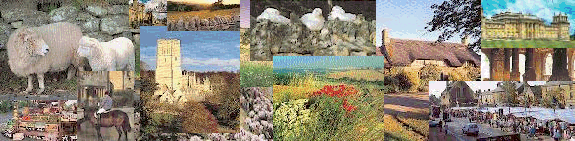
In the Middle Ages the Cotswolds
was well known throughout Europe as the source of some of the best wool. The Cotswolds
were ideal for sheep so the Abbeys and monasteries raised huge flocks of the 'Cotswold
Lions'. These native sheep were large animals with golden long fleeces. Merchants became
rich and spent much money on the wool churches as well as building fine houses for themselves
such as Grevel's House in Chipping
Campden. At that time 50% of England's economy was
due to wool. |
 |
| The world-famous row of cottages at Arlington Row, Bibury was originally
constructed 600 years ago as a factory for processing wool. In the 18th century cloth
manufacture became centred on the Stroud
valleys where there was plenty of waterpower,
and at its height there were about 150 mills. Many still exist today, although, used
for other purposes. |
The Stone
The Cotswolds are very rich in Oolitic
Limestone and so it was natural to start building with it in the Middle
Ages due to its propensity and comparative cheapness. There are still
a good few quarry's in the region still extracting and working the stone
for repairs and the construction of new buildings. The old limestone
houses and cottages are invariably 'Listed' buildings which means they
are tightly projected by the authorities from alteration from the original
and any new buildings invariably have to be built of limestone with matching
roof pitches of 60 degrees.
The colour of the stone of the 'chocolate box' villages does vary
depending on the location of where it was quarried. Generally, in the
northern part of the Cotswolds the stone is a beautiful 'honey golden
brown' and the further south towards the city of Bath the stone becomes
'creamier' in colour. The Cotswolds has more specially protected or
'listed' buildings of any other region. |

|
The Land
|
|
|
The Cotswolds
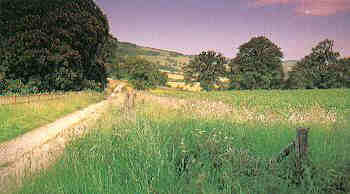
is designated 'An Area of Outstanding Beauty' and is the largest in the UK stretching
from Chipping Campden, in the north, to Bath in the South (78 miles), covering an area
of 2038 sq. kms (790 sq. miles) and comprises farmland over 80% of its area. It has
the largest number of conservation areas of any region. The Cotswolds area of outstanding
natural beauty has been shaped by people for over 6000 years. |
The People
The Cotswolds is home to 85000 people
and has one of the lowest population densities in England with less than
300 residents in over half its parishes. The region attracts 38 million
visitors a year with tourism being the principle industry, generating
over £130 million a year. The Cotswolds
has one of the highest non-urban growth rates in the Country. |
Prehistory
The Cotswolds is rich in Neolithic
remains with about 80 long barrows of the Cotswold-Severn type. Belas Knap is one of
the largest, whilst you can actually crawl inside the fine example of Hetty Pegler's
Trump. The Bronze Age is represented by the remains of some 400 round barrows. The area
is also home to the majority of the 32 Iron Age hill fortes . |
 |
For further interesting information on the History
and Heritage of the Cotswolds
Cotswold
Dry Stone Walls - February 2004
Cotswold
Ridge and Furrows - October 2003
The Rollright
Stones - June 2003
|
|
|
|
|
|
|
The Cotswolds
Heritage of
Wool and Stone
|
Towns
and Villages
to Visit in the Cotswolds
Cotswolds
Tourist Information - Towns and Villages in the English
Counties of Oxfordshire Gloucestershire Warwickshire
Wiltshire Worcestershire and Somerset making up the
Cotswolds region:- Places
to Visit Home
Ablington, Amberley,
Armscote,
Banbury,
Bath,
Batsford, Bladon,
Bibury,
Bisley, Blockley,
Bledington, Bourton-on-the-Water,
Broadway,
Broadwell, Broad
Campden, Buckland,
Burford, Castle
Combe, Charlbury,
Cheltenham, Chipping
Campden, Chipping
Sodbury, Cirencester,
Duntisbourne
Leer, Eastleach
Martin, Evesham, Fairford, Gloucester, Great
Tew, Greenfield
Village,
Guiting
Power, Hidcote
Bartrim, Laverton,
Lechlade,
Little
Barrington,
Little
Faringdon,
Longborough, Long
Compton, Lower
Slaughter,
Mickleton, Minster
Lovell, Moreton
in Marsh,
Minchinhampton, Nailsworth,
Naunton, North
Cerney, Northleach,
Oxford, Painswick,
Shipston
on Stour,
Snowshill, Shipton
under Wychwood,
Stanton, Stow
on the Wold,
Stratford upon Avon,
Stroud, Tetbury,
Tewkesbury,
Upper
Quinton,
Upper Slaughter, Upper
Swell, Willersey,Winchcombe,
Windrush, Woodstock,
Worcester,
Wotton under Edge, Wyck
Rissington
|
|
Places
to Stay in the Cotswolds
Places
to Stay Hotels Bed and Breakfast (B&B's) Guest Houses
Inns Pubs Self-Catering Cottages in the Cotswolds:- Places
to Stay Home
Armscote, Banbury, Barringtons, Bath,
Bibury, Bledington,
Blockley, Bourton
on the Water,
Broadway, Burford,
Cheltenham, Chipping
Campden, Chipping
Norton, Cirencester, Darlingscott,
Evesham, Fairford, Gloucester,
Guiting Power, Mickleton,
Moreton in
Marsh, Minchinhampton,
Oxford, Nailsworth,
Northleach, Painswick,
Shipston on Stour, Snowshill,
Stow on the Wold, Stratford
upon Avon, Stroud,
Tetbury, Tewkesbury,
Willersey, Winchcombe, Witney,
Woodstock, Worcester, Wotton
under Edge.
|
|
|
|
|